For my last weekend in India, I went to Hyderabad to visit some friends from Stanford and to see the city. Hyderabad is about 350 miles northeast of Bangalore, in Andara Pradesh state. It's known locally as "Cyberabad" and by many accounts has taken the mantle of India's Silicon Valley from Bangalore. Bangalore and Hyderabad are similar in many ways, so I will describe Hyderabad mostly in contrast to Bangalore.
Hyderabad was actually one of the nicer cities that I have been to in India. It was pretty similar to Bangalore in appearance, but a little nicer and better organized. The downtown was more substantial than Bangalore. There were many nice looking shops and a few nice looking parks. The roads were fairly well paved. Traffic was terrible, but did not seem quite as bad as Bangalore.
A quick history note. Bangalore is basically a British town. It was just a small village when the British came in the mid-1800s and used it as a hub to monitor south central India. Hyderabad on the other hand was ruled by a strong maharajah. It was one of the few regions of India to never be ruled by the British, and it only joined with the rest of the country some time after Indian independence. As a result, Hyderabad has an interesting culture and unique feel to it where Bangalore largely does not. This NYT article describes the rocks that give Hyderabad some of its character. Perhaps another sign of Hyderabad's position versus Bangalore - I have 5 Stanford classmates who are working in Hyderabad this summer while I am the only one in Bangalore now.
But, Hyderabad's heavy Stanford presence made this weekend a good opportunity to catch up with some friends from school. On Saturday, my friends Jim and Anu picked me up at the airport for a day of sightseeing. We saw the Chaminar (a 16th century monument to the ending of a plague), the Mecca Mosque (a big mosque whose arch contains soil from Mecca), and ate some great biryani (like Indian paella). We also went to the big Fort which overlooks the town, which was pretty cool. Unfortunately at the fort the South Indian monsoon brought the noise. We got completely soaked, and eventually opted to cut our fort visit short. We headed home and skipped viewing Hyderabad's famous Buddha Statue (which sits on a pedestal in the lake in the center of town).
It turned out that the rain was fortunate, as Saturday evening tragedy stuck Hyderabad. Two bombs exploded Saturday night in the city, one at the park by the Buddha Statue, and one at a local restaurant. Over 40 people were killed and dozens more were injured. 19 other bombs were found unexploded around Hyderabad Saturday night and Sunday, as security was stepped up.
Hyderabad's population is about a 50/50 Hindu/Muslim mix, which makes its Muslim population much higher than most Indian cities. It is not clear if this is why Hyderabad was targeted, if it was targeted because of its growing high-tech presence, or even who was behind the attacks. The local government immediately pointed to Pakistan or Bangladeshi terror groups, but it is not clear whether there is any evidence to justify that connection.
I heard of the bombings on Saturday evening at dinner with Jim and Anu. Jim works for Google, and one of his coworkers called him to let us know and to tell us to come back to Google's campus. We finished dinner pretty quickly and headed home. I stayed there with Jim and another GSB guy, Stephen, who was out of town until late Sunday night. Sunday, Google did not allow us to go into town, which was probably wise. Instead, we stayed around Google's campus in Hi-Tec City (Google employees here have an awesome setup incidentally, with unlimited food and drink, access to 24 hr car service, a nice gym, etc), went to the nearby Novotel hotel for a great Sunday brunch with another classmate Ohad and his wife, and crashed the Novotel pool. A bit of a surreal day, spent mostly trying to relax and settle back into a normal life.
The bombings really brought home India's terrorism problem, of which I had largely been blissfully ignorant. I now at least understand why the airports and public buildings have such extensive (if amazingly poorly implemented) security measures. Since 2004, India has had more deaths from terrorism than all of North America, South America, Europe, and Eurasia COMBINED. Over 3,674 people have died over the past 3 years and 3 months, making India the country with the 2nd most terrorist deaths (less than Iraq but more than Afghanistan).
All in all, I still have a favorable impression of Hyderabad as an Indian city. If I were ever to be forced to return to India for work, I would likely prefer Hyderabad to Bangalore. But I am sure it will forever be connected in my mind with the dark cloud of terror.
Showing posts with label India Economy. Show all posts
Showing posts with label India Economy. Show all posts
Monday, August 27, 2007


Friday, August 24, 2007
India vs. China
This summer I have had the amazing opportunity to work back-to-back in the world's two fastest growing economies. Here are some comparisons and observations.
Facts and Figures:
It's hard not to think that China is going to take over the world when walking around Shanghai. The economic growth and energy is palpable. In India, however, walking around any city you definitely do NOT get that impression. Poverty is everywhere, and the palpable feeling is that of walking around an "emerging" economy.
It seems quite true that China has grown because of its government and India has grown in spite of its.
The Indian government cannot handle the simplest issue. Being a democracy with so many diverse viewpoints effectively paralyzes the government. It is true that India makes fewer mistakes as a result, but it is a clear economic disadvantage. The Chinese government on the other hand, is not at all afraid of crushing a few (or few million) individuals or individual liberties in the name of progress. I am nobody to judge which approach is better, but they could not be more different.
What will happen next?
Currently, both countries face a number of similar and significant challenges.
Both countries are trying to move beyond their core strengths (and into the other's territory). India is expanding its manufacturing capabilities - for example, Dell and Nokia have recently opened large plants here. China is also trying to capture more of the IT market. It's IT revenues are currently about 40% of the size of India's. But China's IT market grew at 22% a year and with greater English adoption may grow even faster. Currently, 80% of India's technology exports go to the US or UK. 60% of China's go to Japan or Korea. Both are trying to become more balanced.
Both countries have major political risks that are discounted in the west. India has both Kashmir and the Northeast Provinces with large separatist movements. In addition to Taiwan, China faces problems in Tibet and Southern China, which is increasingly overrun with crime. Both countries face uprisings and riots from farmers on a daily basis. Both have major issues with water and energy shortages and pollution problems (all probably worse in China).
Both countries also face major economic risks. Japan and the other "Asian Tigers" all had significant depressions after growing for approximately as long as China and India in the most recent expansion. China's stockmarket has also gotten to extremely high valuations which are bound to come down in the near-term.
Both also will face major challenges as currency appreciation hurts their cost competitiveness. The rupee has risen nearly 15% this year vs. the dollar. Economists estimate that the yuan is between 10 and 50% undervalued because it is not allowed to freely float.
And both face competition from other emerging Asian economies. The NYT has recently written about the Japan/India partnership that is emerging to combat China. And many global companies and venture capital firms are looking to Vietnam, the Philippines, and elsewhere to provide the next source for cheap labor.
Still though, I think both countries are largely poised for a strong future and while it may not be a smooth ride, I think they will overcome these hurdles. China, particularly, has already become so large and economically powerful that it's rising consumer class should help it continue to grow even if its exports begin to suffer.
Perhaps unsurprisingly, I think over the next 10-15 years the US will grow at 3-5%, India will probably grow at 5-7%, and China will probably grow at 7-9%. But I think India' growth should be pretty stable, barring a major war. I think China's growth faces some significant risks and volatility in the near-term. As a result, I don't think China will catch up to the US as quickly as some people have projected (this recent NYT article seems to agree).
Which would I choose?
If I had to choose to be a farmer in either country, I would probably choose China (though it would be very close, I'd probably be slightly richer and more educated in China but would have less freedom).
If I were to be Me but born in one of the countries, I would definitely choose China because of the huge potential for great wealth (even though I would probably have to live with a permanent face mask to survive the pollution).
Still though, if I could choose to be born anywhere, while it may change in 50 years, today I would almost certainly still pick the US. Hmmm...or maybe Sydney.
Facts and Figures:
- China is the world's biggest country with ~1.32 billion people. India is the world's second biggest country with ~1.10 billion people.
- China is almost exactly the same size as the US in land area. India is about 1/3 of the size of the US in land area.
- China's 2006 GDP was $2,720B, which is $2,069 per capita. India's 2006 GDP was $923B, which is $842 per capita.
- On a purchasing power basis, China's GDP is $7,539 per capita. On a purchasing power basis, India's GDP is $3,920 per capita.
- China's five year GDP growth rate has been 10.1%. India's five year GDP growth rate has been 7.8%.
- China's economy is the 4th largest in the world on a nominal US dollar basis but 2nd on a purchasing power basis. India's economy is the 12th largest in the world on a nominal US dollar basis but 3rd on a purchasing power basis.
- 21% of Chinese exports go to the US. 17% of Indian exports go to the US.
- ~350 million Indians speak English (more English speakers than any other country). Estimates of Chinese English speakers range from 50-275 million. (Though in practice, I have had no trouble getting by in English in India but in China it was often impossible)
It's hard not to think that China is going to take over the world when walking around Shanghai. The economic growth and energy is palpable. In India, however, walking around any city you definitely do NOT get that impression. Poverty is everywhere, and the palpable feeling is that of walking around an "emerging" economy.
It seems quite true that China has grown because of its government and India has grown in spite of its.
The Indian government cannot handle the simplest issue. Being a democracy with so many diverse viewpoints effectively paralyzes the government. It is true that India makes fewer mistakes as a result, but it is a clear economic disadvantage. The Chinese government on the other hand, is not at all afraid of crushing a few (or few million) individuals or individual liberties in the name of progress. I am nobody to judge which approach is better, but they could not be more different.
What will happen next?
Currently, both countries face a number of similar and significant challenges.
Both countries are trying to move beyond their core strengths (and into the other's territory). India is expanding its manufacturing capabilities - for example, Dell and Nokia have recently opened large plants here. China is also trying to capture more of the IT market. It's IT revenues are currently about 40% of the size of India's. But China's IT market grew at 22% a year and with greater English adoption may grow even faster. Currently, 80% of India's technology exports go to the US or UK. 60% of China's go to Japan or Korea. Both are trying to become more balanced.
Both countries have major political risks that are discounted in the west. India has both Kashmir and the Northeast Provinces with large separatist movements. In addition to Taiwan, China faces problems in Tibet and Southern China, which is increasingly overrun with crime. Both countries face uprisings and riots from farmers on a daily basis. Both have major issues with water and energy shortages and pollution problems (all probably worse in China).
Both countries also face major economic risks. Japan and the other "Asian Tigers" all had significant depressions after growing for approximately as long as China and India in the most recent expansion. China's stockmarket has also gotten to extremely high valuations which are bound to come down in the near-term.
Both also will face major challenges as currency appreciation hurts their cost competitiveness. The rupee has risen nearly 15% this year vs. the dollar. Economists estimate that the yuan is between 10 and 50% undervalued because it is not allowed to freely float.
And both face competition from other emerging Asian economies. The NYT has recently written about the Japan/India partnership that is emerging to combat China. And many global companies and venture capital firms are looking to Vietnam, the Philippines, and elsewhere to provide the next source for cheap labor.
Still though, I think both countries are largely poised for a strong future and while it may not be a smooth ride, I think they will overcome these hurdles. China, particularly, has already become so large and economically powerful that it's rising consumer class should help it continue to grow even if its exports begin to suffer.
Perhaps unsurprisingly, I think over the next 10-15 years the US will grow at 3-5%, India will probably grow at 5-7%, and China will probably grow at 7-9%. But I think India' growth should be pretty stable, barring a major war. I think China's growth faces some significant risks and volatility in the near-term. As a result, I don't think China will catch up to the US as quickly as some people have projected (this recent NYT article seems to agree).
Which would I choose?
If I had to choose to be a farmer in either country, I would probably choose China (though it would be very close, I'd probably be slightly richer and more educated in China but would have less freedom).
If I were to be Me but born in one of the countries, I would definitely choose China because of the huge potential for great wealth (even though I would probably have to live with a permanent face mask to survive the pollution).
Still though, if I could choose to be born anywhere, while it may change in 50 years, today I would almost certainly still pick the US. Hmmm...or maybe Sydney.
Wednesday, August 22, 2007
Today's Top Stories
I make a point to read the Times of India every morning. Almost every day there are some priceless gems that come out of the Indian news. Here are today’s top 5 stories as chosen by me.
5. A group of dabbawallas in Mumbai just received the Six Sigma Excellence award from IIT. Dabbawalla loosely translates to “lunch driver”. Basically, this is an organization of men who go around to the homes of office employees who live too far from work to come home from lunch. They pick up lunches that were home cooked and transport them by bicycle to people’s offices. People can then have fresh hot lunches prepared by their loving wives. Mumbai's 5,000 dabbawallas deliver move than 200,000 meals per day and have an error rate of around 1 in 6 million! This is even more impressive when you consider that few of the wallas can read, so they use a system of colored ribbons and easy to memorize letter combinations to find their destinations. The New York Times also recently profiled these dabbawallas.
4. Page 2 of the Bangalore section details where the power outages will be in the next few days. Today, from noon to 2pm, almost all neighborhoods that I recognized would be without power. From Friday to Monday, an even bigger list of neighborhoods was told to expect “intermittent power”.
3. The Sanjay Dutt saga continues. Sanjay has been in jail for just over 3 weeks. Indian law states that convicted criminals must be furnished with a written copy of the judgment against them so they can read the verdict and determine whether they should appeal. In the Sanjay Dutt case, this judgment is expected to be quite long, around 600 pages. Due to the length of the judgment and the backlog in the justice system, they expect that it will take 2 months before a copy of the judgment can be given to Sanjay. Since they do not have a copy of the judgment and therefore can not properly consider his appeal, his defense team applied for bail. Bail has been granted, so Sanjay will go free until the court can give him a written copy of his verdict. But, since the bail processing paperwork takes some time, he remains in jail. His bail was approved on Monday but he will probably not be actually freed until Friday. He will have to return to jail as soon as he receives his copy of the verdict. Can you imagine if this happened in the Michael Vick case!?
2. There was a long article about the “reverse brain drain” that the US is facing. It is becoming more and more difficult for professionals to get visas to work in the US. At the same time, India and China are becoming more attractive places to live and work. Many smart and talented immigrant Americans that in the past would have gotten visas in the US are returning home. Over the past ten years, 1 in 4 new businesses was stated by an immigrant entrepreneur. Chinese or Indian visa holders filed over 40% of new patents in the US in the last 10 years. And, as the US is making it harder for smart scientists and engineers to stay in the states, we are not just hurting our businesses but we are helping start competitors in China, India, and elsewhere.
1. A Member of Parliament introduced a new bill yesterday that would require married male Indians to bring with them a signed permission slip from their wife to travel outside India. To pass through immigration, an Indian married man would have to show his passport, any needed visas, and this signed permission slip. This is intended to cut down on Indian men leaving the country to travel on business and not returning, leaving their wives and families estranged. The Times did not opine on whether the bill would pass.
5. A group of dabbawallas in Mumbai just received the Six Sigma Excellence award from IIT. Dabbawalla loosely translates to “lunch driver”. Basically, this is an organization of men who go around to the homes of office employees who live too far from work to come home from lunch. They pick up lunches that were home cooked and transport them by bicycle to people’s offices. People can then have fresh hot lunches prepared by their loving wives. Mumbai's 5,000 dabbawallas deliver move than 200,000 meals per day and have an error rate of around 1 in 6 million! This is even more impressive when you consider that few of the wallas can read, so they use a system of colored ribbons and easy to memorize letter combinations to find their destinations. The New York Times also recently profiled these dabbawallas.
4. Page 2 of the Bangalore section details where the power outages will be in the next few days. Today, from noon to 2pm, almost all neighborhoods that I recognized would be without power. From Friday to Monday, an even bigger list of neighborhoods was told to expect “intermittent power”.
3. The Sanjay Dutt saga continues. Sanjay has been in jail for just over 3 weeks. Indian law states that convicted criminals must be furnished with a written copy of the judgment against them so they can read the verdict and determine whether they should appeal. In the Sanjay Dutt case, this judgment is expected to be quite long, around 600 pages. Due to the length of the judgment and the backlog in the justice system, they expect that it will take 2 months before a copy of the judgment can be given to Sanjay. Since they do not have a copy of the judgment and therefore can not properly consider his appeal, his defense team applied for bail. Bail has been granted, so Sanjay will go free until the court can give him a written copy of his verdict. But, since the bail processing paperwork takes some time, he remains in jail. His bail was approved on Monday but he will probably not be actually freed until Friday. He will have to return to jail as soon as he receives his copy of the verdict. Can you imagine if this happened in the Michael Vick case!?
2. There was a long article about the “reverse brain drain” that the US is facing. It is becoming more and more difficult for professionals to get visas to work in the US. At the same time, India and China are becoming more attractive places to live and work. Many smart and talented immigrant Americans that in the past would have gotten visas in the US are returning home. Over the past ten years, 1 in 4 new businesses was stated by an immigrant entrepreneur. Chinese or Indian visa holders filed over 40% of new patents in the US in the last 10 years. And, as the US is making it harder for smart scientists and engineers to stay in the states, we are not just hurting our businesses but we are helping start competitors in China, India, and elsewhere.
1. A Member of Parliament introduced a new bill yesterday that would require married male Indians to bring with them a signed permission slip from their wife to travel outside India. To pass through immigration, an Indian married man would have to show his passport, any needed visas, and this signed permission slip. This is intended to cut down on Indian men leaving the country to travel on business and not returning, leaving their wives and families estranged. The Times did not opine on whether the bill would pass.
Impressions of Venture Capital
During my time here at Softbank, I have gotten to work on a few pretty cool deals. I have looked at a company that sells POS and ERP software to retailers here in India. I have worked on a start-up that is looking to sell financial services to India's middle class consumers. I have also looked into the online search market here in India. It has all been pretty interesting.
Here are a few of my impressions, both of VC generally and in India specifically:
Venture Capital firms generally look at a very small business and provide capital to hopefully make a very large business 3-7 years later. In the US, the major considerations are market risk (how big will this market be in 5 years), competitive risk (what other firms can capture substantial share of this market), and management risk (is this a team that can successfully build this business). There are also financial/valuation considerations, though this is substantially less important in venture investments than later stage investments.
In India, however, there are two major complications. First, the market risk is much bigger, because almost all markets are very small today, and any investment needs huge market growth to succeed. Secondly, the emerging economy risk is very significant also. This involves government decisions largely out of control of the firm, macroeconomic risks, and political risks that are largely non-existant in the US.
As a result, Indian Venture Capital is still a tiny industry. There are only 6-8 funds who are doing early stage venture deals in India. There are more private equity firms providing growth capital to larger companies, but really very few providing true venture money to emerging businesses or entrepreneurs.
The companies that VC's look at in India are also incredibly small. This is probably true in the US as well, but lots of the companies that we look at have 0-$100K in annual revenues. But in India, you can still have a mid-sized workforce at this size.
There are also a lot of foreign investors who don't really understand the Indian market but who will pay any price to enter. For example, the third largest coffee chain in India just sold for US$120MM to an Italian chain. They have about 30 stores, so the chain paid about$2.5MM per site, an amazing price for a small chain of Indian coffee shops. (For comparison, Starbucks which is obviously a substantially bigger brand trades for $1.7M per site). Lastly, a few other VC's I have talked to here tell stories of how many entrepreneurs just "add a zero" at the end of their actual cash flow projections so that the VC's who want to invest meaningful dollar amounts by US standards will talk to them.
While working as a VC has been interesting, my three biggest complaints about the venture business are:
Much of the VC business is just networking. Tons of time is spent going to conferences, trying to meet entrepreneurs, and trying to find experts who know what the next big thing is. I don't think I am a bad networker, but it's not my favorite thing.
VC investing is often a herd mentality play. This is sometimes well justified, as any fund who did not get into google underperformed the last VC bull market. But mostly, it just plays out as everyone is looking for the next big social networking site, everyone is looking for the next big mobile media company, but everyone is really just doing the same thing without really knowing what's going to work.
I think VC economics are not that compelling. From a fund standpoint, with the exception of the few top VC funds whose brand names give them real proprietary deal flow, VC funds generally underperform the general market. They also do not scale. VC funds simply cannot make enough seed investments to deploy a few billion dollars of capital like LBO funds can. As such, funds stay small and carry is small.
All that said, there are a lot of things that are very cool about being a VC. You get to spend a lot of time trying to figure out how new markets are going to emerge and how you can invest capital to affect and capture a share of that growth. You also get to meet a lot of smart and interesting entrepreneurs with cool ideas for new businesses. But I'm still just not sure it's my number 1 career choice.
Here are a few of my impressions, both of VC generally and in India specifically:
Venture Capital firms generally look at a very small business and provide capital to hopefully make a very large business 3-7 years later. In the US, the major considerations are market risk (how big will this market be in 5 years), competitive risk (what other firms can capture substantial share of this market), and management risk (is this a team that can successfully build this business). There are also financial/valuation considerations, though this is substantially less important in venture investments than later stage investments.
In India, however, there are two major complications. First, the market risk is much bigger, because almost all markets are very small today, and any investment needs huge market growth to succeed. Secondly, the emerging economy risk is very significant also. This involves government decisions largely out of control of the firm, macroeconomic risks, and political risks that are largely non-existant in the US.
As a result, Indian Venture Capital is still a tiny industry. There are only 6-8 funds who are doing early stage venture deals in India. There are more private equity firms providing growth capital to larger companies, but really very few providing true venture money to emerging businesses or entrepreneurs.
The companies that VC's look at in India are also incredibly small. This is probably true in the US as well, but lots of the companies that we look at have 0-$100K in annual revenues. But in India, you can still have a mid-sized workforce at this size.
There are also a lot of foreign investors who don't really understand the Indian market but who will pay any price to enter. For example, the third largest coffee chain in India just sold for US$120MM to an Italian chain. They have about 30 stores, so the chain paid about$2.5MM per site, an amazing price for a small chain of Indian coffee shops. (For comparison, Starbucks which is obviously a substantially bigger brand trades for $1.7M per site). Lastly, a few other VC's I have talked to here tell stories of how many entrepreneurs just "add a zero" at the end of their actual cash flow projections so that the VC's who want to invest meaningful dollar amounts by US standards will talk to them.
While working as a VC has been interesting, my three biggest complaints about the venture business are:
Much of the VC business is just networking. Tons of time is spent going to conferences, trying to meet entrepreneurs, and trying to find experts who know what the next big thing is. I don't think I am a bad networker, but it's not my favorite thing.
VC investing is often a herd mentality play. This is sometimes well justified, as any fund who did not get into google underperformed the last VC bull market. But mostly, it just plays out as everyone is looking for the next big social networking site, everyone is looking for the next big mobile media company, but everyone is really just doing the same thing without really knowing what's going to work.
I think VC economics are not that compelling. From a fund standpoint, with the exception of the few top VC funds whose brand names give them real proprietary deal flow, VC funds generally underperform the general market. They also do not scale. VC funds simply cannot make enough seed investments to deploy a few billion dollars of capital like LBO funds can. As such, funds stay small and carry is small.
All that said, there are a lot of things that are very cool about being a VC. You get to spend a lot of time trying to figure out how new markets are going to emerge and how you can invest capital to affect and capture a share of that growth. You also get to meet a lot of smart and interesting entrepreneurs with cool ideas for new businesses. But I'm still just not sure it's my number 1 career choice.
Saturday, August 18, 2007
How flat is the world really?
To start, two animal updates.
First, I can't believe I forgot to mention this but on the drive from Cochin to the Snake Boat Race in Kerala, we passed 5 elephants on the "highway". First, one elephant alone. Then a group of 3. Then a final lone elephant.
First, I can't believe I forgot to mention this but on the drive from Cochin to the Snake Boat Race in Kerala, we passed 5 elephants on the "highway". First, one elephant alone. Then a group of 3. Then a final lone elephant.
Second, the big news in the paper yesterday was that a leopard had come out of the forest in the Bangalore suburb of Hosur and had gotten into the big shopping mall there. It terrorized crowds of people and injured 8 people before being tranquilized and returned to the forest.
Friday I went on a tour of Infosys's campus. Profiled in The World is Flat (the new version of which also starts with a big section on Georgia Tech), Infosys is the largest technology consulting/outsourcing firm in India. Infosys had its first high profile success implementing solutions to Y2K. Now, it is a large technology consulting conglomorate. Much of their work is quite similar to the work I did at PwC implementing SAP at Delta.
Infosys has just over 70,000 employees, about 3/4 of which are in India. They have three massive campuses in India (Bangalore, Mysore, Pune) and a number of smaller locations. The Bangalore campus is the 2nd biggest and is often described as a Corporate Disneyland. There are 18,000 workers spread around a massive enclosed area that looks like a college campus. People take golf carts and ride bicycles around campus. There are five huge food courts, a number of putting and chipping greens, volleyball courts, basketball courts, and several gyms. There is also a huge modern conference room with the largest flat screen tv in Asia. And since Indian infrastructure is so unreliable, the campus is completely self sufficient in terms of power, water, waste processing, etc. Finally, the campus has its own 3.5 star hotel with over 300 rooms. All summer interns live on campus in the hotel, and most corporate guests stay there as well.
Infosys is the "most admired company" in India, they get over 1 million job applications per year. They still have a significant turnover problem though, as qualified labor is difficult to find and keep. Their annual turnover rate is in the 15-20% range, which they say is lower than Tata, Wipro, Accenture India and other competitors, but still is quite high on an absolute basis.
It will be interesting to see what happens to Indian firms like Infosys. I am less bullish on outsourcing to India than I was before I arrived here. I don't think the Indian offshoring market is going away, or even that growth will stop, but I think it will grow at closer to 10% rates than 50%.
Talent is becoming more expensive to find and keep, and while software engineers do not make US salaries, they are getting closer. While a Chinese manufacturer may have a ~20-40x cost advantage in its labor force (I am ballpark estiamting hourly 50 cent - $1 Chinese labor vs $20 US labor), these firms have only a 2-3x cost advantage. This cost advantage has also been hit hard by recent appreciation of the rupee. Additionally, Infosys's clients are more and more demanding their consultants come work on site. This neutralizes Infosys's cost advantage. It also hurts the Infosys culture - especially since many of their employees are drawn to Infosys because of the opportunity to work on one of the massive campuses.
Finally, the overall outsourcing market is much smaller than I expected. Most people talk about how India is a "service" economy, and how ~40% of its GDP comes from services. While that is true, "services" largely does not mean services provided to Western countries. The entire Indian Technology (consulting/outsourcing/KPO/BPO) industry is only about US$10B today. By contrast, the US bought $290B worth of goods from China in 2006.
In their most aggressive case, Forrester Research estimates that by 2015 a total of 7.5 million jobs could be sent offshore by all western economies. Even if you assume 100% of those jobs went to India, India's workforce in 2015 will be at least 300 million people (and could be much more). So at most, only 2.5% of Indian jobs could come from the offshoring industry.
While a $10B outsourcing market is not tiny, I am less afraid that my job will be sent to India than I was three months ago. If I had a job, that is.
Friday, August 17, 2007
Kerala - La Casa de Madhu
When I was working in Shanghai, one of my GSB classmates, Bret, was also working there. We hung out a few times, and he introduced me to his coworker Seph. Seph goes to MIT b-school and has been in Bangalore for the past few weeks. A couple weekends ago, one of Seph's classmates, Dave, came to Bangalore for the weekend. So I met Dave, who is working in Trivandrum, the capital of Kerala. Dave's classmate Ashesh is from Cochin, Kerala. Ashesh emailed his cousin, Madhu, to say that Dave and I were going to the Snake Boat Races. And, for some reason, Madhu insisted on organizing our trip to Kerala, driving us around, and playing host for the weekend.
Given our not-exactly-direct connection, I was not entirely sure what to expect. But sure enough, when I got off the airplane Friday night, Madhu was there to pick me up. He was an absolutely amazing host (especially since he had no idea who I was!) He had arranged a hotel for me, so he drove us into town to check in. Then we went out to dinner and to a bar where we hung out until about midnight. Saturday morning he drove us down to the backwaters where we had lunch, met Dave, and headed to the races. After the races, he drove Dave and I back to Cochin where we went out to dinner. Sunday morning, he came and picked us up and drove us around for a full day of sightseeing. We then dropped Dave off at the train station to go home, but my flight was not until 8pm. So we went to Madhu's house, where I met his wife and children. We drove his daughter to her boarding school (about an hour away), before finally he took me to the airport.
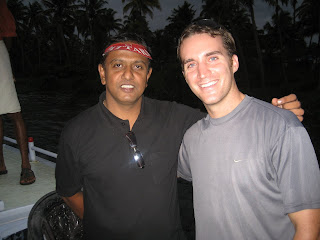
In addition to his unbelievably amazing hospitality, Madhu is a really interesting guy. He is 42 years old and has an 11 year old daughter and a 5 year old son. His father started a seafood business which is now and run by Madhu and his brother. His brother runs the operations side, and Madhu runs sales and marketing. This involves extensive travel, particularly to Europe which is apparently a big buyer of Indian shellfish. In the past two decades, he has lived in Spain, Portugal and England, as well as all over India. He speaks Tamil, Hindi, Urdu, Malayam, English, Spanish, Portuguese, Italian, and German. We listened to his Shakira cds on the way to the race and joked in Spanish about the Fiesta de los Barcos. What a great guy.
 It was awesome getting the chance to spend 20+ hours talking with a knowledgeable local about anything and everything Indian. I learned a lot about Cochin and Kerala, which is a really interesting place.
Some facts and findings:
Cochin is one of the oldest port cities in India, and it was the first burial site of Vasco de Gama. The old town has Portuguese, Dutch, Chinese, and English cultural and architectural influences.
The oldest church and oldest synagogue in India are both in Cochin. A slight majority of Cochin's residents today are Indian Catholics. There are also a few Indian Jewish residents as well. They live in a part of town subtly called "Jew Town," mostly on "Jew Street".
 Cochin has the world's only Spice Exchange, where cinnamon, cardamom, pepper, etc are actively bought and sold on the trading floor.
Kerala is known for its seafood, and we had some amazing fish. We had several fish curries, a few different varieties of fried fish, and a great local dish that was like fried anchovies (surprisingly good bar snack).
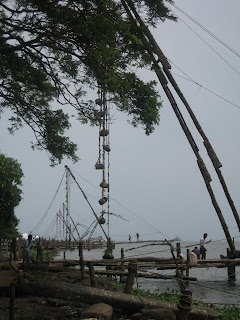
Locals fish with these Chinese fishing nets that were supposedly introduced by Kublai Khan. The huge nets are operated by four men who raise and lower them with a rock and pulley system. They do not use bait, but the rising tides trap fish in the nets, which are lowered for about 2 hours at a time.
 Cochin has the nicest airport in India. It was built by a public/private partnership, and now has international flights to five countries even though Cochin has only 1 million people.
Most men in Kerala wear dress shirts, dhotis, and flip-flops. Dhotis are basically a sheet that is wrapped around your legs like a towel, then tucked in the front. It looks a bit like a big diaper, but is supposedly quite comfortable. I hope this someday becomes acceptable business casual wear in the US.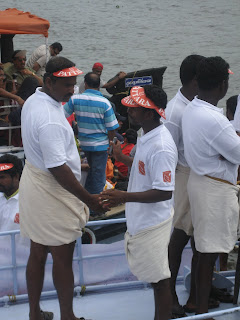 Even though Kerala is a Communist state, Cochin has a new and booming IT industry. Investors from Dubai are in the middle of constructing one of the largest IT parks in India just outside Cochin. Despite the government's best efforts to slow things down, investment is booming and real estate prices are soaring.
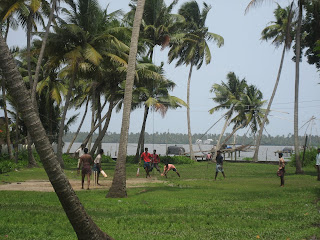
Finally, like everywhere in India, cricket is the most popular sport. A local pickup game.
Given our not-exactly-direct connection, I was not entirely sure what to expect. But sure enough, when I got off the airplane Friday night, Madhu was there to pick me up. He was an absolutely amazing host (especially since he had no idea who I was!) He had arranged a hotel for me, so he drove us into town to check in. Then we went out to dinner and to a bar where we hung out until about midnight. Saturday morning he drove us down to the backwaters where we had lunch, met Dave, and headed to the races. After the races, he drove Dave and I back to Cochin where we went out to dinner. Sunday morning, he came and picked us up and drove us around for a full day of sightseeing. We then dropped Dave off at the train station to go home, but my flight was not until 8pm. So we went to Madhu's house, where I met his wife and children. We drove his daughter to her boarding school (about an hour away), before finally he took me to the airport.
In addition to his unbelievably amazing hospitality, Madhu is a really interesting guy. He is 42 years old and has an 11 year old daughter and a 5 year old son. His father started a seafood business which is now and run by Madhu and his brother. His brother runs the operations side, and Madhu runs sales and marketing. This involves extensive travel, particularly to Europe which is apparently a big buyer of Indian shellfish. In the past two decades, he has lived in Spain, Portugal and England, as well as all over India. He speaks Tamil, Hindi, Urdu, Malayam, English, Spanish, Portuguese, Italian, and German. We listened to his Shakira cds on the way to the race and joked in Spanish about the Fiesta de los Barcos. What a great guy.
Me and Madhu at the race:
 It was awesome getting the chance to spend 20+ hours talking with a knowledgeable local about anything and everything Indian. I learned a lot about Cochin and Kerala, which is a really interesting place.
Some facts and findings:
Cochin is one of the oldest port cities in India, and it was the first burial site of Vasco de Gama. The old town has Portuguese, Dutch, Chinese, and English cultural and architectural influences.
The oldest church and oldest synagogue in India are both in Cochin. A slight majority of Cochin's residents today are Indian Catholics. There are also a few Indian Jewish residents as well. They live in a part of town subtly called "Jew Town," mostly on "Jew Street".
 Cochin has the world's only Spice Exchange, where cinnamon, cardamom, pepper, etc are actively bought and sold on the trading floor.
Kerala is known for its seafood, and we had some amazing fish. We had several fish curries, a few different varieties of fried fish, and a great local dish that was like fried anchovies (surprisingly good bar snack).
Locals fish with these Chinese fishing nets that were supposedly introduced by Kublai Khan. The huge nets are operated by four men who raise and lower them with a rock and pulley system. They do not use bait, but the rising tides trap fish in the nets, which are lowered for about 2 hours at a time.
 Cochin has the nicest airport in India. It was built by a public/private partnership, and now has international flights to five countries even though Cochin has only 1 million people.
Most men in Kerala wear dress shirts, dhotis, and flip-flops. Dhotis are basically a sheet that is wrapped around your legs like a towel, then tucked in the front. It looks a bit like a big diaper, but is supposedly quite comfortable. I hope this someday becomes acceptable business casual wear in the US.
 Even though Kerala is a Communist state, Cochin has a new and booming IT industry. Investors from Dubai are in the middle of constructing one of the largest IT parks in India just outside Cochin. Despite the government's best efforts to slow things down, investment is booming and real estate prices are soaring.
Finally, like everywhere in India, cricket is the most popular sport. A local pickup game.

Saturday, August 4, 2007
The Malls of Bangalore
One of the biggest malls in India is not far from my house. Not much else interesting is near my house, so I have already made two trips there.
I wrote some about the amazing economic dichotomy in China. This is the first real place that I have found it here. In fact, in northern India, there was much less dichotomy than I expected. Maybe this was just circumstantial, but during my two weeks in northern India, I was not able to find any upper class areas. Almost everyone I met was in poverty or at most in the lower middle class. There was little dichotomy - everyone was poor.
Supporting my crude impression, McKinsey divides India today into five economic classes. The lowest two buckets - the "Deprived" and the "Aspirers" make up 94% of society. The Middle Class equivalent bucket makes up only 4%, while the top 2 buckets (upper middle, and upper class) each only make up 1% of society.
But here in Bangalore, that small middle class makes its presence felt, at least a little. And the mall by my house is one example of this. The mall has nice depatment stores, medium-high end brand stores (Tommy Hilfiger, Nike, Adidas, to name a few), an Apple reseller store, and a nice bookstore. No Prada or Gucci or super-premium brands, but still some pretty nice stores. There is also a Pizza Hut, McDonalds, and a food court with lots of fast Indian food and other Asian food. I had some chicken and rice from a place called Yo!China for dinner. Not great, but it sort of satisfied my first Chinese craving in a while. I also got a US$3 gelato from a pretty good ice cream place.
The mall does have a few weird aspects though:
To enter the mall, everyone has to walk through a metal detector. This metal detector is about 3 feet wide, and everyone tries to squeeze through it as fast as possible. So there are always multiple people going through it at the same time. And you do not have to take the metal detectors out of your pockets or take metal out of your bags. But the detector never, ever beeps. So there is a huge 30ft wide glass entrance to the mall, a line of people squeezing through a tiny metal detector under the watchful eye of security, and absolutely no point to any of it.
After dinner one night, I headed to walk home. But outside, it had started pouring. I asked a guy where I could get an umbrella. He pointed to a store on the second floor. I trudged up there, and asked where the umbrellas were. The clerk said that they did not have any. I asked where in the mall I could get one. He said he did not think anyone in the mall sold umbrellas, but maybe I could go to a few blocks down the street. How does a mall not sell umbrellas in a city where they have a monsoon season?
Also, for a while I got stuck behind three women trying to get on the escalator. They were stopped at the bottom of an up-moving escalator, giggling and not moving. A little confused, I tried first to get around them, couldn't, then stepped back to watch. A few other people came up and tried to get by but couldn't either. After a bit, it became clear that these women (or at least 2 of the 3) had never ridden an escalator before. They were dressed in their "sunday best" sarees for the trip to the mall. They seemed to be in their 40s or 50s. All seemed to be having the best time. Finally, two of them bit the bullet and did a small leap on to the escalator. The third did not jump. The first two shriked with joy. The third smiled, shrugged, turned, and walked up the stairs next to the escalator. All three hugged at the top.
Finally, I bought the new Harry Potter book today. It cost R975, or about US$25. For perspective, I spent R300 / night in Leh for my hotel. But the Harry Potter phenomenon is amazing. India's infrastructure and logistics capabilities are incredibly bad. There are few good roads, almost no runnning water, and the power goes out every few hours. In Jaipur, for a specific example, residents have running water for 15-20 minutes per day. Yet somehow, in every city and town of any size that I went to, you could find the new Harry Potter book. Today, I caved and bought it. Somehow, it seemed necessary.
I wrote some about the amazing economic dichotomy in China. This is the first real place that I have found it here. In fact, in northern India, there was much less dichotomy than I expected. Maybe this was just circumstantial, but during my two weeks in northern India, I was not able to find any upper class areas. Almost everyone I met was in poverty or at most in the lower middle class. There was little dichotomy - everyone was poor.
Supporting my crude impression, McKinsey divides India today into five economic classes. The lowest two buckets - the "Deprived" and the "Aspirers" make up 94% of society. The Middle Class equivalent bucket makes up only 4%, while the top 2 buckets (upper middle, and upper class) each only make up 1% of society.
But here in Bangalore, that small middle class makes its presence felt, at least a little. And the mall by my house is one example of this. The mall has nice depatment stores, medium-high end brand stores (Tommy Hilfiger, Nike, Adidas, to name a few), an Apple reseller store, and a nice bookstore. No Prada or Gucci or super-premium brands, but still some pretty nice stores. There is also a Pizza Hut, McDonalds, and a food court with lots of fast Indian food and other Asian food. I had some chicken and rice from a place called Yo!China for dinner. Not great, but it sort of satisfied my first Chinese craving in a while. I also got a US$3 gelato from a pretty good ice cream place.
The mall does have a few weird aspects though:
To enter the mall, everyone has to walk through a metal detector. This metal detector is about 3 feet wide, and everyone tries to squeeze through it as fast as possible. So there are always multiple people going through it at the same time. And you do not have to take the metal detectors out of your pockets or take metal out of your bags. But the detector never, ever beeps. So there is a huge 30ft wide glass entrance to the mall, a line of people squeezing through a tiny metal detector under the watchful eye of security, and absolutely no point to any of it.
After dinner one night, I headed to walk home. But outside, it had started pouring. I asked a guy where I could get an umbrella. He pointed to a store on the second floor. I trudged up there, and asked where the umbrellas were. The clerk said that they did not have any. I asked where in the mall I could get one. He said he did not think anyone in the mall sold umbrellas, but maybe I could go to a few blocks down the street. How does a mall not sell umbrellas in a city where they have a monsoon season?
Also, for a while I got stuck behind three women trying to get on the escalator. They were stopped at the bottom of an up-moving escalator, giggling and not moving. A little confused, I tried first to get around them, couldn't, then stepped back to watch. A few other people came up and tried to get by but couldn't either. After a bit, it became clear that these women (or at least 2 of the 3) had never ridden an escalator before. They were dressed in their "sunday best" sarees for the trip to the mall. They seemed to be in their 40s or 50s. All seemed to be having the best time. Finally, two of them bit the bullet and did a small leap on to the escalator. The third did not jump. The first two shriked with joy. The third smiled, shrugged, turned, and walked up the stairs next to the escalator. All three hugged at the top.
Finally, I bought the new Harry Potter book today. It cost R975, or about US$25. For perspective, I spent R300 / night in Leh for my hotel. But the Harry Potter phenomenon is amazing. India's infrastructure and logistics capabilities are incredibly bad. There are few good roads, almost no runnning water, and the power goes out every few hours. In Jaipur, for a specific example, residents have running water for 15-20 minutes per day. Yet somehow, in every city and town of any size that I went to, you could find the new Harry Potter book. Today, I caved and bought it. Somehow, it seemed necessary.
Subscribe to:
Posts (Atom)
