Check out my most recent blog posts:


Showing posts with label China travel. Show all posts

Friday, July 20, 2007

Hong Kong/Macau

Hong Kong was a good way to finish China. Actually it was not much of a finish to China but more of a trip back to the US. It definitely felt less Chinese than many parts of San Francisco and New York do. Everyone spoke English, tons of ex-pats (largely British and Australian), and a very modern city.

A few highlights from touring the city include the 800 meter long set of escalators that takes you from down by the waterfront up to the mid-levels on the hill where most of the hotels are, eating a Burger King Big Fish sandwich up on top of Victoria's Peak, a few nice ferry rides around from high-en
d shopping mall to shopping mall, and finding hot, fresh krispy kreme donuts.


One of the highlights was definitely a random night out Friday. The Stanford group I met in Yunnan also happened to be in Hong Kong for the night, so we met up for a big fun dinner. For different portions of the meal, I brought a few friends who were in town from school and from New York. The other group also had a few friends who lived in Hong Kong. Thosew friends brought some more friends. We ended up having one of those great its-a-small-world nights with a good italian dinner that could have been in little italy and then a few sierra nevadas at a brewpub that could have been in san francisco.

The last stop on the China circuit - Macau - was a pleasant surprise. It had many things I like: cool casinos, lots of waterfront areas, and great portuguese food.

The town/SAR/country of Macau still retains a lot of its Portuguese heritage. Signs on stores were an interesting mix of portuguese and cantonese with occasional bits of english haphazardly thrown in. It was pleasant, walkable and felt more like being in Peru than in China. I even managed to get a workout in one of the parks. The blackjack dealers at the Wynn however were not so welcoming.

Friday, July 13, 2007

Lijiang - an epilogue

First - some background. I do not mean this to be negative or too stereotypical, but I need to make a broad generalization. Please don't be offended.

Chinese tourists love taking solo photographs in front of random places. Without fail, older Chinese tourists give a stoic semi-smile, and younger people flash a peace sign. All photos are individual only. In fact, Lijiang may only exist in order to give Chinese tourists random places to take individual photos.

Ok, enough context, on to the story.
My last afternoon in Lijiang I walked about 30 minutes north of the old town to Black Dragon Pool Park. Just a few steps inside, a torrential downpour started. I had no rain jacket or umbrella so I scampered to the nearest pagoda for shelter. Since I am Dola-e, I had many electronic devices in my pocket that I was not eager to get wet. So I sat under the pagoda and started to read my book.

After a half hour, I got tapped on the shoulder. It was an old Chinese woman, probably in her 50s, holding a camera and an umbrella. Thinking she wanted me to take her pictures, I stood up and took her camera. She gave me the umbrella also. A little surprised, I took it, then followed her out into the rain. She stood out in the rain at a few classic random spots, and I snapped photos. Then she ran back over, looked at the digital photos, approved, and took the camera and umbrella and headed back under cover. Now a mix of stunned and amused, but definitely getting wet, I followed her back to the pagoda.

Then she started to gesture excitedly and talk loudly to me in Mandarin. Eventually, I realized she wanted to set up a trade of sorts. I could take her photos along the way, and she would share her umbrella with me. I laughed, thought for a second, then agreed.

At first we walked along a little awkwardly. She would stop, set up a photo shoot, and I would take a pictures. But soon, we struck up a great dialogue. She spoke rapid Chinese. I replied in English. Neither understood a word the other was saying.

Eventually, we settled into a great routine. She even offered to take a few pictures of me random places, and I accepted.

As we got closer to town, we started getting some funny looks from strangers as we huddled together under the umbrella, but we just giggled like a happy couple and continued on.

Finally, we got to a big water wheel with some other people nearby, and I gestured to ask if we could get a picture together. She smiled, flagged down a stranger, and we took pictures on both of our cameras. I wanted to include the umbrella, she yelled at me to put it down. I held it awkwardly off to the side.

Soon though, we had to go our separate ways. She led us to a little store and arranged for me to buy my own umbrella for Y10. We turned and looked at each other one last time, she said "Bye-Bye", I laughed and said the same, then turned and headed home under my new lavender umbrella.

Wednesday, July 11, 2007

Lijiang, China wrap-up

To elaborate more on the Colorado analogy from earlier, if Kunming is Denver, then Lijiang is a weird version of Aspen and Shangri-La is Durango, or Moab Utah, or something like that.


Lijiang may be the weirdest place I have ever been. It is at least in theory an ancient Chinese town home to the Naxi minority tribe. In practice, it is a bizzare cross between Disney World, Las Vegas, and Williamsburg Virgina, except in China.


But still, I have spent a pretty chill couple days here and have enjoyed my stay.

Thanks to Shu, I am staying in a really cool tea house owned by one of her friends with an amazing view over the city. I am the first white traveler to stay there. Last night, the owner force-fed me beer until 1:30am as we sort of communicated through hand gestures and laughter for a few hours.

I have spent lots of time walking around the old town and chilling in cafes (amazingly, I had french toast at a place this morning that was playing a Miles Davis cd)

I got a 2 hour massage from a blind man that was largely phenomenal but at times more than a little uncomfortable.


And now, today, my legs and back ache. My forehead is peeling from sunburn in a ridiculous checkerboard pattern that would probably not be considered attractive. My clothes are filthy. After six weeks here, I have breathed pollution equivalent to smoking a pack of cigarettes every day for 5 months.

But I am happy.

This morning, I saw bright blue sky for the first time in China. It seemed appropriate that this comes on my last day, here in Lijiang, one of the most difficult places to understand in all of China. While I am headed to Hong Kong and Macau for the weekend, this is my last day in the "mainland".

At times, China has been unwelcoming, frustrating, and baffling. And at other times, it has been unbelievably friendly, spectacular, and amazing. I think China and I battled at least to a draw, or maybe even I came out slightly ahead. In any case, it has been extremely interesting and rewarding. I already can't wait to come back.

Landslide!

I think the best way to start this story is with a description of my luggage. You will see why this is relevant shortly.

I arrived in Kunming with 3 bags. One large duffel bag with my work clothes. One midsized day pack full of souvenirs and hiking supplies. One large backpack full of stuff for my week in Yunnan. I left the large duffel bag and the mid-sized pack at the Kunming airport when I flew to Shangri-La.
At the start of the hike, the weather did not look very good. I knew the trail was steep and slick, and I did not have a cover for my large pack. I had bought a tiny pack for US$8 in Shangri-La (where a bunch of North Face gear had "fallen off a truck" and was being sold for cheap). After much internal debate, I decided that I would leave my large pack at a guest house at the start of the trail, fit whatever I could into the small bag, and go with that.
So in addition to what I wore and had in my pockets, I brought for the hike:
1 spare pair of socks, 1 spare pair of underwear, a poncho, 4 clif bars, 4 half liter bottles of water, a book, my passport, a few pages describing the hike torn out of the Lonely Planet, about Y600, and a couple credit cards.
Notable items not on this list include (among other things):

Head lamp, advil, celebrex, spare clothes, a knife, dry shoes or sandals, my wallet.

The last object is particularly noteworthy since I was paid by Kijiji in cash (no electronic payments possible from China to US). So I have a few thousand dollars cash balled up in the bottom of my pack. I decided to leave it in my big pack because my day pack had absolutely no place to hide it. I decided it would be safer stuffed in the bottom of a dirty old pack at the start of the trail, since the Lonely Planet mentioned that solo foreign travelers should beware of thieves.

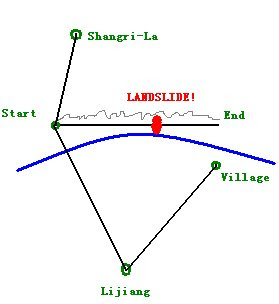
Until the avalanche came, scattering my belongings all around Yunnan to save weight seemed brilliant. But the landslide blocked the only road between the end of the hike and the start of the hike. Note the map below: The trail is in gray, the only road in black, the river through the gorge is in blue, and the landslide is in red. I am at the end of the hike. My stuff is at the start of the hike. I need to go to Lijiang.
It quickly dawned on me that I was in the middle of nowhere in Yunnan China, knew nobody, had a cell phone that didn't work, did not speak Chinese, was soaking wet, and all I had with me was about $50, a pair of dirty socks and underwear, and 1 last clifbar.
I hiked as fast as my tired legs would go uphill to a little cafe at the end of the hike. I got there around 12:30. There were 7 other travelers there including my new friend from Guangdong Province, another guy who turned out to be from Beijing, and 5 Israelis. I immediately attached myself to the hip of the two Chinese speakers.
After about 30 minutes of discussing the situation, we decided to hire a car for Y5 each to take us to the landslide. We would see if we could walk through it. If we could, we would hire a car on the other side to take us to the start of the hike. This seemed like a reasonable enough plan, so I hopped in a minivan (sidenote: the chinese word for minivan is loaf-of-bread-car) with the two chinese guys. The Israelis argued for about 20 minutes and finally 3 of them decided to come with us, leaving the other 2 temporarily at the cafe.
We headed off on the crazy, windy road with no guardrails and 2,000 foot sheer drops towards the landslide. Along the way, we passed about 3 small landslide areas any one of which undoubtedly would have closed any road in the US. We barely slowed down to avoid the boulders and waterfalls. Then, we saw it: the entire road was covered for about 30 yards with huge boulders. Definitely no cars getting through.
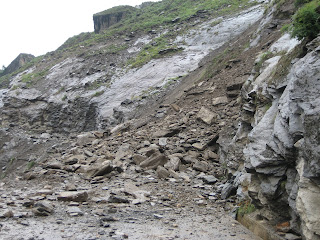
We got out to inspect the situation. It might have been possible to scamper through the landslide to the other side. The big problem was that there was still rocks that kept falling. Little rocks and dirt were falling continuously and would have made the ground very slick. Rocks about the size of a person's head fell every few seconds. They could probably be avoided, but if they hit you, they would definitely knock you off the cliff. And every few minutes, person-sized boulders would tumble down.
After discussing the situation for a few minutes, we decided to turn back. To punctuate the decision, a huge rock fell about 10 feet from where we were standing on the road. We quickly got back in the minivan and returned to the cafe. A mid-sized rock bounced off the side of the van as we drove off.

Along the way back to the cafe, I was discussing the situation with my new best friend from Guangdong. I told him that I needed to get back to the start of the hike to get my pack, so maybe I would just hike back. While walking 8 hours back to the start of the trail seemed far less than ideal, I couldn't come up with any better options. He suggested that I call the cafe at the start of the trail and have them send my bag to Lijiang. I was amazed at this idea. He explained the idea to the woman at the end of the trail cafe. She called the woman at the cafe at the start of the trail. After about 10 minutes of discussion, they said that I could pick up my bag that night at "Mama's" Guesthouse in Lijiang. It would cost me 15 Yuan (US$1.95) for the delivery. I quickly accepted the offer. Now all I had to do was get to Lijiang (and hope my bag did too).
Back at the cafe, I stayed as close to the lone minivan as possible. A few more travelers arrived and were also trying to sort out the situation. There were rumors that we could take a car to a ferry, take the ferry across the river, then try to find a car on the other side to take us to Lijiang. The two Chinese guys arranged for the minivan to drive us to this ferry crossing, so I hop in again. The Israeli's again tried to figure out how to split up. In the meantime, I met a white American guy! This was the first American I had met in 5 days in Yunnan. We got to talking and it turned out he is a CS Masters student at Stanford (Sergey) who was traveling with 2 Chinese-American Stanford girls (Carri and Diane)! I told them to quickly get in the van, we ditched the still arguing Israelis, and took off.

We drove along about 30 minutes mostly on these dirt farm roads through some corn fields vaguely towards the river. Eventually, the path ended, and the driver said we should get out. We paid him Y10 each, he pointed off in the distance, and said it is 500 meters to the water. We set off.
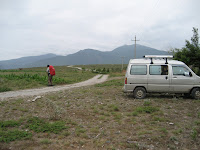
After nearly an hour of uncertain hiking (definitely more than 500 meters), we reached the cliffs and followed a winding path down to the river. Across the river, we could see a boat and a few caves where it looked like somebody could live. After a few minutes of yelling, a ferryman woke up, came down to the river, and brought his boat across the river to get us.
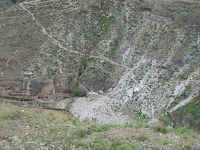

We took the ferry across the river for Y15.

On the other side, we climbed up a trail from the water to a dirt road. We followed this dirt road for about 30 minutes towards a cluster of buildings that was supposedly a village. Finally, we got to the first building which was a guesthouse. By now it was about 4:30. The two Chinese guys decided to spend the night at the guesthouse and take a bus the next morning to Shangri-La. The Stanford kids and I both wanted to get to Lijiang. There were no more buses. But the owner of the guesthouse eventually said that the village's one car could be hired to drive us to Lijiang for Y300 at 7pm. We accepted.
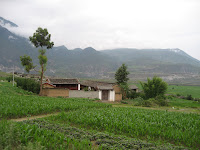
Still though, we had almost 3 hours to kill, so we wandered into "town". This was as stereotypical a Chinese village as you can imagine. One dirt road through town with a few shacks surrounding it. Chickens wandering in the street, a few donkeys, etc. The little kids all ran into the street and wave and yell at me and Sergey (I imagine not many white travelers make it in these parts). We did not see any cars for about 30 minutes.

Suddenly, a mini-bus rumbled down the street towards us. We flagged it down. After about 2 minutes of amazing negotiation by Diane, the mini-bus driver agreed to take us right then to Lijiang for Y300. We immediately jumped in and we took off, ecstatic that success was finally in sight.

A few small adventures later (we switched cars once and drivers twice for no apparent reason), we finally arrived after about 3 hours on bumpy dirt roads at Lijiang around 8pm. I found my way to "Mama's" within about 20 minutes, and sure enough my backpack was there, contents entirely intact! I have no idea how it got there.

Total cost of the trip: Y5 (car 1) + Y10 (car 2) + Y15 (ferry) + Y75 (bus) + Y15 (bag) = Y120 or about $15.

We decided to celebrate that night at a local bar which was of course named "The Sexy Tractor". And obviously, the bartender was a Chilean guy who used to live in Brazil. I told him I lived in Sao Paulo for a while, and we talked in Portunol for a bit. He pulled out some Cachaca from underneath the counter and made me an awesome caiprinha. Amazing end to a crazy day.

Shangri-La to Tiger Leaping Gorge

[Note: I am on the slowest internet connection in the world. More photos to follow soon]

I think I did not emphasize enough in my previous post how cool of a little town Shangri-La was. It's really small Tibetan village, with stone streets, little shops and restaurants and the occasional hostel, and two very cool monastaries - one on a little hill in town and one that we cycled to. There is also a big square where there is some sort of Tibetan dance party nightly. A little touristy, but still pretty cool. Some photos:

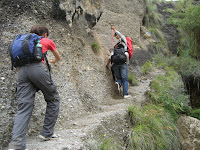
Monday morning I woke up in Shangri-La with no real plans, looked outside, saw that it was overcast but not raining, and decided to go do the Tiger Leaping Gorge hike. This is one of the most famous hikes in Yunnan Province, and runs through a gorge that is over a mile deep.

I left Shangri-La on the 10am bus for the little town of Qiaotou ("Chow-toe") where the hike starts. The bus was fairly nice - better than Ecuador, worse than Peru. I dozed off for a bit and woke up when the bus made a stop and then started again. Confused, I asked the guy next to me "Qiaotou?". He said something. Iasked again. He said something that seemed like yes. I yelled to the driver "Qiaotou?" He stopped. I hopped off, got my bag, and trudged back up the hill to Quiatou.

The Gorge hike is around 20 miles long. It starts around 1000 feet above the river at the west end of the Gorge. It then climbs up 3000 feet in the first 5 miles, then goes up and down and eventually descends back down to 1000 feet above the river over the last 15 miles. Top altitude is around 8500 feet. At the end of the hike, there is an optional 3 hour excursion down to the river.

Since the rainy season makes hiking tricky, my plan was to hike for as long as possible when it wasn't rainy too hard. I started around 1:00. As the weather rotated from light drizzle to steady rain but was never a downpour, I hiked until it started to get dark - about 6 hours. It was tough going, and quite slippery and wet, but a really cool hike. The mountains that surround the area are even higher than the gorge - their peaks are over 16,000 feet - and their tops poked through the clouds every so often like I was in the Lord of the Rings.

The weather scared away many travelers so I did not see very many people. But I also had a goofy wide-brimmed hat which I could tell made everyone I passed super jealous. I totally sunburned my newly exposed forehead, neck, and scalp while cycling outside Shangri-La. High-altitude sun and newly short hair do not go well together.

Most people I passed on the trail though had hired a guide with a horse. I hate horses even more than bikes so I did not. Still almost everyone I passed were also saoking wet and had mud-covered spots on their butts (like I did) from falling on one of the slick rocks. But I managed to find my way even though at times the trail was

not well marked:


crowded:

unclear:

probably not that safe:

and definitely wet:

But in the end, it was definitely worth it. The hike got progressively better, and it was awe-inspiring by the time I arrived Monday night at a little guest house that offered dinner and a place to crash for less than $4.

I woke up early and hiked the rest of the trail Tuesday morning, then trekked down to the bottom of the Gorge and climbed out on Tiger Leaping Stone in the middle of the river.

At the bottom of the river, I met a nice Chinese traveler from Guangdong province. As he was the only other person I saw on the 3 hour trip down to the river and back up, we chatted a bit and took a photo together. He took off first, I stayed a bit on the rock, then went up a few minutes later. As I was sweating and out of breath about half way back up, I ran into two guys who were headed down to the water. They mentioned that there had been a landslide in the road and that travel out of the gorge would be "challenging". That was an understatement - I will elaborate on the adventures that followed in the next post.

But the hike was exhausting, I was soaking wet for two days, but it was very cool, had great views, and was a great way to re-connect with nature after spending a month in the very urban lifestyle of Shanghai.

Sunday, July 8, 2007

Shangri-La

It's been a whirlwind 48 hours since I wrote last so I will try to describe a few of the things that have happened.


First, Friday was my last day at Kijiji. Everyone gathered to take a photo (below) as I was leaving which was very cool.


Then I went out with the GSB crew to great Cantonese dim sum and then to karaoke with a bunch of Shu's friends. I knew it would be an interesting experience but it was crazier than I imagined. The place felt sort of like a nice casino, with big marble floors and high ceilings, chandeliers, great service, and fancy private karaoke rooms. Everyone was so in to singing it was crazy. I expected that, but it was more intense and more fun than I thought. Kind of like Lost in Translation, but with bigger, nicer rooms. Our GSB group sang Sweet Home Alabama, though I mostly banged on the tambourine to drown out my voice.

I left bright and early Saturday for Kunming, Yunnan. I have decided that Yunnan is equivalent to Colorado, and Kunming is Denver. There are mountains all around, a pretty unique culture that is not like California and not like the East Coast. I am probably not explaining this analogy very well, but the point is Kunming is a pretty cool city, especially for China. Very little pollution, a really nice downtown, some great pagodas and temples and a great lake. I spent a very pleasant 6 hours there, then hopped on a plane to Shangri-La.


Shangri-La is in the very Northwest corner of Yunnan/Colorado. Despite it's technical location in Yunnan, Shangri-La is a Tibetan town. All the people I have met have classified themselves as Tibetan, they dress and eat Tibetan food, and many of the local people are monks at one of the local Tibetan Buddhist Monasteries. [A quick note on Tibet, the people that we met here say that Westerners falsely associate the Tibetan culture with the Tibet SAR that is designated by the Chinese government. There are many Tibetan villages in the provinces that border that border Tibet SAR.]


I checked in to my hostel last night the same time as two Dutch travelers, so the three of us went out to check out the town and grab dinner. The town has a really cool monastery on the top of a little hill which was great. Then we went out and had a surprisingly good dinner of dried yak meat, pickled potatoes, and barley noodle balls.


Today we rented mountain bikes to explore the area. I will not write more about my dislike for the act of biking but I survived off road biking in the Himalayas on my first day at altitude (the town is at 3200 meters, surrounding area is higher) with only one bleeding knee.


But the best part of biking was that we got to see all sorts of off the beaten path things. We met a monk who took us into one of the monastery's kitchens and had yak tea with us (absolutely gross but amazing experience). We went through all sorts of gorgeous valleys with flowers and yaks and yak sheppards and Tibetan people going around the daily work. Everyone was super friendly and yelled "Hello" or "Nihao" to us. We went to the biggest monastery outside Tibet and hiked all around it, went through its dozens of cool temple areas, and trekked up through some of the hills and villages around the monastery. Finally we ended up in a huge lake bed and chilled in the fields.


That's all I can write for now. I will upload more pictures to this post later.

Thursday, July 5, 2007

Final Shanghai Thoughts

First, wrapping up some loose ends:

I have been meaning to write about an interesting conversation I had with Jian Shuo about Chinese naming. But he beat me to it and explained Chinese naming much better than I could.

Second, I got a haircut today. A bold move I realize, since “not too short” was not one of the mandarin phrases I have learned. But it’s very hot, and I can’t go the whole summer with no haircut (when I have a job). It was a nice place though, and it is a good haircut, just too short. I look a bit like a white, 5’11” Yao Ming (no disrespect intended for Yao Ming or his hairstyle).

Finally, Beijing is planning to ban 1 million cars from the road for two weeks to test its effect on reducing pollution (Thanks Susan!)

Now, on to some Shanghai thoughts.

I was very surprised when I realized this week that I am not at all ready to leave Shanghai. As everyone knows, I am always ready to move on to try new adventures. But my time here has been great and I wish I could stay longer.

I have been going through and trying to hit some hot spots in my last few nights here. I went to the top of the Grand Hyatt in Pudong for some drinks (although my shorts and flip-flops kept me from the bar on the 87th floor, the view was still pretty cool). I have been back to 3 on the Bund and had drinks at the roof café there overlooking the river. Probably my favorite place in Shanghai. I went back to Xiantiandi and to People’s Square and walked around and ate some food. I went to Yueyuan and bought some souvenirs. I took some pictures from the office and from the walk to and from work.

I think Shanghai is a great city. People complain that it is too much about spending money. They say it’s like New York, but without the cultural and artistic side (though some would say the real culture has been pushed out of Manhattan and into the boroughs anyway). Most local Chinese think Beijing is a better place to live because there is “real culture” there. Apparently there are 10 artists in Beijing for every 1 in Shanghai. That may be true, but I would pick Shanghai over Beijing for sure.

Another common complaint is that Shanghai is too western. I think Shanghai may be western-friendly but it is decidedly non-western. There are definitely McDonald’s and KFC’s and Starbucks all around. But there are countless more tiny restaurants and shops and local establishments. Somehow, the colonial influence of the French Concession and the modern skyscrapers with neon lights work together and give Shanghai a feel that is not western, and probably isn’t Chinese either, but is something all its own.

A few final photos:

Views from the office

Pudong
Xujiahui (taken on my commute)

Tuesday, July 3, 2007

More miscellaneous China thoughts

Language
I am quite proud of my Mandarin development over the past few weeks. I can now do such useful things as: get the waiter and the check (fu yen, my dan), say I am feeling “ok” (ma ma hu hu), and of course order ice cream (bing ji ling).

I can also very consistently tell a taxi driver where I live (near Xujiahui, at Tianyaoquio Lu and Nandan Lu). This morning, it was raining, and I had left both my umbrella and map at the office. I had not successfully taken a cab to the office without the map but I felt confident and hopped in a taxi.

My office is at Guanyuan Xi Lu and Huashan Lu. I struggle with the Yua and Hua sounds. But I tell the driver the address and think I get the point across and we set off. 20 minutes later we are at Guanyuan Lu and Hengshan Lu. Not right. I try again, and we set off again. 10 minutes later we are at Guanyuan Xi Lu and Hongqiao Lu. Not right either. Finally, I convince the driver to just go to Xujiahui. Going to Xujiahui, we pass my intersection. I tell the driver to stop and he says “Oh, Huashan Lu!!” 45 minutes later, I am at the office.

Pollution
The World Bank released a report on pollution in China today that is summarized in the Financial Times. They claim 750,000 people die a year due to the air pollution, though Beijing forced the World Bank to cut that statistic from the final version of the report, saying it would cause “social unrest”. It does say the China has made improvements at curbing pollution over the last few years.

Sino-Japanese relations
I think most people know that Chinese people and Japanese people do not get along. But I did not appreciate how tense the relationship is. Many Chinese truly hate Japanese people after the war crimes that were committed in WWII. In Xi’an, one of our friends joked that he was Japanese and that was why he didn’t speak Mandarin (he actually is from Hong Kong and speaks Cantonese). It went over very badly. Our friends told him to not even joke about that. I have also on several occasions seen World War II referred to as “The War of Defending against the Japanese Invasion”. I don’t think it was used as lightly as the War of Northern Aggression is sometimes used today in the US.

Monday, July 2, 2007

Xi'an

I had a great weekend trip to Xi’an with two GSB friends, Ian and Shu, and an HBS guy Winston. It was a great group to travel with and we had a blast. Ian also had 3 friends of friends in Xi’an who took us out to eat on Saturday night and showed us around. They took us out to eat at a great local place, showed us the “best bar in Xian” (which was quite cool actually), taught us a high-speed variant of paper-rock-scissors that all the people were playing at the bar (which I will be exporting back to the US), and pretty much looked out for us, even though none of us had ever met them. Amazing hospitality.

As I have done a lot of research on Tier 2 cities in China (McKinsey rates Xi’an is a Tier 2a city, meaning one of top 15 local market opportunities in China), I was very curious about what Xi’an would be like. I have heard a lot of stories about problems in Tier 2 cities – pollution, overcrowding from rural immigrants, lack of water, severe economic disparity. But Xi’an was much better than I expected.

Xi’an is an ancient capital of China – until the capital was moved to Beijing in the ~1200s, it was the capital for most of the previous 1500 years. Amazingly, there were still a number of interesting cultural relics – the downtown CBD is surrounded by the old city walls with their huge gates rising up overlooking the city. Lots of palaces, gardens, and pagodas. Some of them were really cool. Occasionally, we trudged up hundreds of steps to get to look out over a hot, smoggy nothingness. But generally, the city sights were great.

Xi’an is also fairly west geographically in China, so it has a large Muslim population. We hung out in the Muslim quarter, and had really good lamb dumplings, kebabs, rice porridge and some other stuff for dinner.

The city also had a much bigger and more vibrant upper middle class than I expected. The main street in town had tons of high-end western brand stores – Gucci, Nike, others – and tons of people were out shopping at the local malls, eating out, and going to bars throughout the weekend. Tons of people at the bar we were at had tables with US$50 bottles of scotch and green tea.

The terracotta warriors were pretty incredible. I could write a lot about them, but I will be brief as there are many internet postings about them. Built by the last emperor of the Qin Dynasty around 300 BC, the warriors are thousands and thousands of terracotta stone warriors, horses, sculptures, and animals buried in dozens of huge pits around the Qin emperor’s tomb to protect him in the afterlife. Each was painted in bright colors (though they have faded now), and every warrior had a unique face, body, etc designed to look exactly like one of the warriors in the actual army. After the emperor died, his son executed all of the thousands of workers who worked on the tomb and buried them inside so nobody would learn the secrets of entering the tomb. As archaeologists fear booby traps will collapse the sites, only a few pits have been opened today.

But the highlight of the terracotta warriors was without a doubt the “Number 1 Umbrella in China”. This bronze umbrella stand was built 2,300 years ago for the emperor. It sat in a base that could rotate, so you could easily spin the umbrella around on its axis depending on the direction of the sun. But, not just that, you could also divide it into two pieces. One half of it because a spear and the other half because a shield (somehow). An amazing and hilarious artifact showing that the fascination with umbrellas is thousands of years old.

In addition to Number 1 Umbrella in China, we also found “Number 1 Fountain in the World”. In downtown Xi’an there is a huge fountain with thousands of spouts. At 2pm Sunday there was a full musical show like you might find at the Bellagio or Disney World. We watched the pretty cool show at Number 1 Fountain* from the top of the Big Goose Pagoda.

Finally, just a few of Xi’an’s memorable signs.


*Unfortunately, the internet does not seem to support Xi’an’s claim of having Number 1 Fountain in the World. In a very quick Google search, Singapore, Saudi Arabia, Michigan, and Arizona all seem to claim fountain titles of some kind.

Thursday, June 28, 2007

Weekend update and food

Weekend
I am going to Xi’an this weekend with two GSB friends, Ian Chiu and Wu Shu, and one of Ian’s friends from HBS. Xi’an is an ancient capital of China in the central part of the country most famous for being the home of the Terracotta Warriors. In characteristic modesty, the Chinese Tourism Bureau says the Terracotta Warriors are the “most significant archaeological excavations of the 20th century.” No more blog entries likely until Monday (China Time).

Food
I haven’t written much about food recently. But that is not because it has gotten less weird, more that I am somehow getting used to it. Earlier this week I went to a hotpot dinner – like the Chinese version of fondue, but weirder. We had some regular beef and lamb and shrimp, but then there was a bunch of stuff like cow stomach, some other cow parts in a red sauce, some balls of some kind (supposedly “meatballs” but they were oddly hollow), etc. I was only a little bit disturbed and we all basically just plowed in. The stomach was quite good (though did not look like something you should be eating) as were the supposed meatballs. The cow parts in red sauce were not my favorite.

Then, since this is Shanghai, you can also get any western food that you want as well (except Mexican food, which is killing me). So the next night I went to a nouveau Mediterranean restaurant on the roof of the modern art museum in People’s Square. The place had great views, and I had a pretty good salad and veal tenderloin. Then I went to a cool bar in Xiantiandi that had a jazz band in from New York. Could have been anywhere in the world and seemed as far away from cow stomach as possible.

Finally, I have been eating a ton of dumplings. Averaging about 25/day this week of all different types. My favorites are xiao long bao (steamed soup dumplings) and sheng jian (grilled? jumbo dumpling) .There is a hole-in-the-wall place a few blocks for our office that has been called the best dumpling place in the world. It’s tiny, and dirty, and crowded, but really good. And today at lunch there, I ran into a guy who grew up in Norcross and went to the same middle school and high school as me and who is my brother Michael’s friend. Crazy.

Finally, an interesting article from the People’s Daily – What will China be like in 2050? Hopefully I get time to elaborate on some of my thoughts next week.

Tuesday, June 26, 2007

Hangzhou

On Sunday I went with 5 people from Kijiji to Hangzhou, a little town 2 hours by train west from Shanghai. Although I am calling it a town because I had never heard of it, it has about 6.5 million people. So city may be more appropriate.

When Marco Polo found Hangzhou in the 1200s, he called it “Paradise on Earth”. Most Shanghainese think it is the most beautiful city in China. I agree that it is quite nice – there is a huge lake in the middle of the city called Xihu (West Lake). It has all sorts of lotus blooming in it, mountains rising up all around it, a number of big pagodas and little tea houses, and two really long stone bridges that were built in the 300-400s that lead out to a little island in the center of the lake.

We got to Hangzhou around 11:30 and had a nice lunch in an old Chinese house. Then we walked all along the lake, admired the scenery, took photos and generally goofed around. As I have mentioned before, often decisions get made in Chinese and I am only consulted at the last minute. Around 3:00, I get asked if I know how to ride a bike. Hesitantly, I answer yes. And of course, next thing I know we have rented bikes.

As many of you who have ridden bikes with me in Ireland, the beach, or my triathlon, I am a good bike rider when there is nothing around me, but when there are objects nearby – anything from elderly Asian women to pesky water bottles – I tend to hit them. The thought of riding a bike around packed Chinese streets was a bit terrifying.

Also the bikes that we rented were very small – kind of like a regular bicycle, except you couldn’t turn the handlebars hard and peddle at the same time because your knees will hit them. And there was only 1 gear.

We start out riding on these paths near the lake. Not so bad. Then we go around the bend and there are tons of people and bikers and these trams that shuttle people all around. But I discover that I have a little bell. So I keep peddling along, sweating like crazy, and ringing my bell all the time and just hoping people get out of my way. There were a few close squeezes when the path got narrow. And once I ran into a bush (but bounced out and recovered nicely). No major disasters.

Then we get to the end of the path, and take a turn for a major road. Now we add cars and buses to the mix. I am sure I am going to die. We keep going for a bit, I sort of get used to driving near chaotic traffic, and everything seems ok. Except I am very ready to be done biking and it has only been 20 minutes. Finally, we get to a huge tunnel and which of course we decide to go through. There are two lanes of traffic and a “bike lane” on the right side. A tiny little bar divides us in the “bike lane” from the road. And there is not much room between this bar and the tunnel wall. I am struggling to just stay in a moderately straight line and not tip over into traffic and get run over. Then, this beeping comes from behind me and won’t stop. I quickly look over my shoulder and see a moped in the bike lane! I squeeze as close to the wall as I can and hope for the best. Sure enough, he starts to pass me. He zipped by me, and I bounced off the wall but gracefully managed to straighten things out and keep on peddling. The tunnel kept going and going and going – it was probably only 6 or 7 minutes really – but finally I made it out, and eventually back to the lake. I am done with biking.

One final Hangzhou story – since it was supposed to rain, I brought a rain jacket and wore cargo shorts instead of bringing a backpack. I brought my iPod, camera, some clifbars, passport, wallet, cards, etc. I am not sure exactly why, but everyone was amazed by how much stuff I had managed to bring with me. Apparently, there is a Japanese cartoon cat that has magic powers and can pull anything out of her “pockets” whenever she wants. So now, my Chinese nickname is “Dolae” because I resemble this female Japanese cartoon cat. Great.

More photos later, but for now:
Xihu (West Lake)
Team photoOur Triumphant HeroSunset at XihuStud with umbrellaDorae (I hope there is no resemblance)

Monday, June 25, 2007

Three random stories from the weekend

Dogs

We saw someone walking their pet dog in Hangzhou, so it prompted a conversation about dogs: pets or food? A warning – what follows is a terrible story.

Apparently most people here who keep dogs as pets do not eat dogs. But many other people do. Our Product Manager, Victor, had a pet golden retriever. He called it Big Yellow (or I guess the Chinese equivalent of Big Yellow). A few weeks ago, he heard a yelp from his dog in the middle of the night. He woke up and stumbled downstairs to check on Big Yellow. Two beggars/thieves had broken into his house, killed his dog, and were eating it! Really sad.
Everyone at the office felt bad for him, though one of the guys – Dengjia, who particularly likes dog – was (jokingly) angry that somebody else had gotten to Big Yellow first!

Text Messages
On the train to Hangzhou, I got a few text messages in Chinese from a number I did not know. After the second one, I asked somebody to read them. Apparently, when you enter a new city, that city often sends you a welcome text message, saying hello, telling you the current weather, and providing a tourist hotline in case you have any questions. None of the locals found this was even remotely interesting or unusual, but I thought it was amazing.

Umbrellas
It is considered more attractive in China (and maybe Asia more broadly?) to be light-skinned rather than dark skinned. Just as American women spend all sorts of money on tanning beds, tanning lotions, and who knows what else to make their skin look more tan, women here spend a ton of money on skin whitening products. When a woman gets too suntanned, her friends jokingly tell her that she would “be popular in the West”.

The extension of wanting whiter skin is being afraid of the sun. So whenever it is sunny, all the girls walk around with umbrellas. That in itself is not so big of a deal. But in Hangzhou, I saw a girl riding a bike and holding an umbrella to protect from the sun at the same time! As most people know, I cannot ride a bike with just one hand for more than about a second, so I found it particularly stunning. This practice is not very common and I was too slow to get any action shots, but here is a photo of my friend Ellen stopped on her bike talking on her mobile and holding an umbrella.

Sunday, June 24, 2007

Latin night

First an update – I chose trip D. I think the trade off between manageable travel and cool sights will be the best. And I am hopeful about the weather.

I just finished another great weekend that has given me a lot to write about. But it’s late so I will just write about Friday night now and will follow up with more over the next few days. But I will say that today was my highest risk travel day since escaping from the volcano last summer.

Friday was my friend Armando’s last night in Shanghai so we went to a “Brazilian” Churrascaria. But there was really nothing Brazilian about it. Everyone there was Chinese, and there were definitely no Brazilian chefs. There was a big salad bar, guys walking around with grilled food on swords, and there was a little card on the table that flipped from red to green. But the similarities ended there. Caipirinhas were not available and there was only one type of steak. But there was a lot of Chinese food brought around on the skewers. And at one point, three guys got up on a stage and sang La Bamba.

All that said - the food was pretty good.

After the Brazilian place, we met up with a GSB friend at a really cool jazz bar where it was Latin Night. This Latin Night was really authentic however. There was a full 9 piece salsa band, and at least 6 of the band members were from Colombia. A largely Latin ex-pat crowd danced and sang in Spanish and Portuguese. Really fun, though my salsa ability in the eastern hemisphere is precisely the same as my salsa ability in the western hemisphere.

Saturday, June 23, 2007

Three small transportation stories

Online booking
I booked a flight “online” yesterday for a trip to Xi’an for next weekend. I used Ctrip.com, the equivalent of Orbitz or Expedia in the US. For the booking process, everything proceeded fairly normally at first. I sorted through a bunch of options, chose my flights and proceeded to booking. Then the payment choices came up. The choices were: (1) pay with a Chinese credit card, or (2) pay cash. I of course had to choose cash, both because I do not have a Chinese credit card and because I needed to see how that would work. I got to choose a two-hour window during the next day during which a Ctrip representative would come to my office and we would make an exchange. Sure enough, he brought me a paper ticket and I paid him in cash.

Error Messages
One of the best Chinese phrasings I have seen. An error message when searching for a flight:

Shanghai - Diqing None of direct flights in this time.


If you can accept the way turn in other airports,The following is the Shanghai that we recommend for you to fly to the Diqing of in turn(onward flight) the flight path.Please choose you feel quite the cheese in turn the city, we will search the service for you

Taxis
I have written before about how difficult it is to take taxis here. It is such a problem that I will write again. First, it is almost impossible to pronounce the address of where you want to go, and taxi drivers never understand what you are saying. So Westerners need to bring a Chinese map and the address written in Chinese of wherever they want to go. But even so, it is still a big question of whether you will actually get where you are going. I have heard a few reasons for that – one being that many taxi drivers don’t read that well, and the other being that since entire areas of town can be seized, torn down, and rebuilt, the landscape changes so fast that taxi drivers can’t keep up. Whatever the case, it is a huge pain to take a taxi anywhere and at all times I keep a Chinese map of my hotel in my pocket and still often don’t get exactly where I want to go.

But, last night I got into a cab after dinner and reached into my pocket. Somehow I did not have my map with me. So we went through a two minute exchange where I tried to say Xujiahui (pronounced something like shoe-jah-hway) and the cab driver stared blankly at me. Finally, he said “Ah! Xujiahui” (to me, exactly the same as I had been saying for two minutes) and off we went. Xujiahui is the metro station about 10 minutes from my hotel and the only landmark I know. We successfully made it to the metro station and then I was able to point and grunt and guide us to the hotel. A huge victory!

Thursday, June 21, 2007

Shanghai sightseeing

Mostly photos in this post.

First, this is why the US will never catch up to China in Science and Math. This is just a random bridge (click to enlarge).


Next an update on some good sights I have seen in Shanghai. First, I went to the Shanghai Museum in the People’s Square. While I didn’t expect it to be very interesting, it was actually pretty cool. Tons of jade, porcelain, Chinese paintings, calligraphy, etc. Which you wouldn’t think would be that interesting, but it was. There were intricate jade carvings from as old as 2500BC. Note the baby being stepped on by the emperor giving the gun show below.

After the Shanghai Museum, I went to the Yueyan Gardens. Also very cool. These are antique gardens and buildings from the Ming Dynasty (1300-1600s) and a touristy but cool surrounding market. (Note the Starbucks and Dairy Queen)

Finally I have walked along the Bund a couple nights. This is the riverfront area that divides Puxi and Pudong new area. It’s a really pretty, very interesting mix of Concession era and modern buildings. The Puxi side of the river is mostly old Victorian buildings and the Pudong side is all new skyscrapers. There are some great rooftop bars and restaurants with especially cool views at night.

Lastly, I took the Shanghai Tourism Tunnel with some friends the other night. It is sort of like a trippy Disney World ride, where you take a little train under the river from Puxi to Pudong. But in an effort to be cool and modern, there are all sorts of psychedelic lights, weird sounds, and inflatable clowns (like you would find on the roof of a car dealer). Despite how it looks in the picture below, we were probably going about 5 MPH. One of the weirdest places I have been in China. Nice views from the other side though.

Wednesday, June 20, 2007

Trip planning – Choose my own adventure!

I am trying to choose among 4 possible trips for the one week I have free in China between jobs. I definitely want to go someplace that is rural and less Western than the big coastal cities. But China is so big and still so unknown to me that I am having a hard time deciding. There is also probably some tradeoff between remoteness of the area and my ability to get around with only 7 words of Mandarin.

Here are the four choices, in no particular order.

Trip A: Tibet

Rough Itinerary: Take the newly opened train (highest train in the world) 50 hours direct from Shanghai to Lhasa. Spend 4 days in and around Lhasa exploring Tibet. See monasteries, yaks, and hike in the mountains.

Pros: Two days on the train means less chance of getting lost. Will get to see a lot of China out the window or could maybe make a stop for a day along the way, not clear. Tibet seems cool and unique, good culture and scenery. Lhasa seems easy to navigate.

Cons: Hard to get a travel visa for Tibet, may be some logistics challenges. Two days trapped on a train may not mean that fun. I’m going to northern India (right across the border from Tibet) later this summer so Lhasa may not be that different.


Trip B: Central China, Gansu province

Rough Itinerary: Three days in Xiahe, a small town in Gansu province. Two days in Jiayuguan, the edge of the desert at the western outpost of the Great Wall.

Pros: Major highlight of Xiahe is Labrang Monastary, largest Buddhist monastery outside Tibet. Good hikes around town, beautiful scenery, very remote location. Town seems very cool. Seeing desert / “end of the world” in Jiayuguan would be cool. Probably the most “off-the-beaten-path” of any trip choices. Probably the best weather of any choice.

Cons: Toughest travel of any option - Xiahe is 6 hour bus ride from the nearest airport. Jiayuguan is easier to get to but not extremely convenient either.


Trip C: Eastern China, Anhui province

Rough Itinerary: Day in Hefei, city trying to become new Silicon Valley of China. Three days of “Village hopping” in small towns in south of province. Two days at Huang Shan, one of most famous and beautiful mountains in China.

Pros: Mountain is supposed to be very pretty. Can stay in little hostels at the summit and hike around. Villages look cool. Could try to meet with the science and technology minister in Hefei which might be interesting. Travel is in fairly compact area, would not need a flight or two many long trips.

Cons: While no long trips, would require fairly frequent arranging of travel (which carries significant language risk). Some rules about where Westerners cannot spend the night which seem confusing. Most touristy of the trips, not positive I would get to see “real” China (or maybe I would?).

Trip D: Yunnan province

Rough Itinerary: Fly to Kunming and spend a day or two there. Do Tiger Leaping Gorge hike and /or see Shangri-La.

Pros: Many people have recommended the beautiful scenery and remote villages, Kunming is supposed a cool 2.5M person city. Mountains and hiking opportunities seem good. Travelers frequently come here and it would be relatively easy to get around.

Cons: I think the weather risk is the biggest here. I heard it rains most of July which makes travel difficult.

What do you think I should do? Please post comments or email me.

Tuesday, June 19, 2007

Ganbei!

Last night was one of the most fun nights I have had in China.

Like many activities in Shanghai, the night began out of nowhere. I am not sure if this is a Kijiji trait or a China trait, but there seems to be no advance warning when something is about to happen. Maybe conversation takes place in Chinese around me and I just don’t get told until the last second, but I am always being asked to do something – go to lunch, dinner, whatever, and then it is instantly time to go. This was no different - I was getting tired and ready to pack up my stuff around 6:45 and head home for a laidback night. Yiyi walked over and asked if I wanted to join some people for a party to celebrate the Dragon Boat Festival. Of course I said sure. And she said, ok let’s go. Less than 10 seconds later I am in the elevator out the door.

First stop on the way to the party was the grocery store. This was the first Chinese Supercenter I have been to. It had a Chinese name (but Tesco owns a portion of it) and was very similar to a Super Walmart in the US – huge, lots of groceries and lots of other stuff. There were some small differences of course, like most chicken and meat was not packaged, it just sat uncooked on ice. People would pick up chicken breasts, look at them, throw them back on the ice chest, and eventually stuff a plastic bag full of them. We picked up a bunch of gross looking food, and I smuggled some Chips Ahoy into our shopping cart.

Then we went to a co-workers apartment (relatively similar to a post-apartment complex) for the party. The “party” was a small group of 7, and almost immediately upon arriving I was sent to work in the kitchen. I tried to explain that I have only cooked spaghetti and microwaved Trader Joes in the past 3 years, but that did not work. So less than 30 minutes removed from my desk, I am making bacon, mushroom and tomato omelettes (they turned out good tasting but unattractive - omelette flipping with chopsticks is hard) in a Chinese kitchen.

Then we had a generally great night talking casually about all sorts of stuff ranging from movies and tv to political issues in China – Big Brother, the Great Firewall, One Family One Child policy, abortion, gay rights, etc. Really fascinating, though a little depressing [note: editing this out, I will elaborate more once I am out of China, just to be safe].

After talking until around 11:00 (the beer really helped people be more comfortable trying to speak english), I introduced the Zeros and Ones game that I learned in Australia which was a total hit. Finally, the beer ran out and we decided to move on to Chinese whiskey which tasted as bad as you would think. We were drinking out of paper cups and the whiskey was so strong that we had to use two cups since it would eat through the bottom of the paper. And I also learned the Chinese word for Cheers – Ganbei! – though it is different from toasting in the US because when someone says Ganbei you have to finish your drink. Lots of fun, but I am glad we did not have a larger bottle.

Saturday, June 16, 2007

First weekend in Shanghai

Friday night’s two activities could not have been more different.

First, I went to dinner with a group of 8 people from work. We went to a little hole-in-the-wall local restaurant on the third floor of a sort of dumpy building a block or so from work called “Yummy Place”. It was not. All meals are family style that I have eaten here where one person (not me) orders for everyone. This dinner worked the same. First dish that was brought out was a pile of chicken feet. Not even fried or breaded, just plain (baked?) chicken feet served with tiny hot peppers. You could see the webbing, toes, everything. I am not normally phased by foods of different cultures but this was one of the least appetizing things I have ever seen on a table. Rest of the dinner was unspectacular. Total cost for the 8 of us was about US$12.

After dinner, I met up with my friend Roy from New York and who is now working in ASCP’s Shanghai office. He had some friends who just graduated from Wharton in town visiting. We went out to a super trendy lounge in Shanghai called Volar, with a world-class crowd in a world-class space (Philippe Starck) and world-class prices. We had table service with US$150 bottles of vodka and green tea/whiskey. About 1/3 the price of a similar place in Vegas, Miami, New York, but with the exception of the 98% Asian crowd, you couldn’t tell a difference. But, our bar tab was almost 40x the price of my entire group’s dinner.

How sustainable is China’s economic growth like this? I am mentally composing a much longer separate post about this, but the disparity here between rich and poor is incredible. And China is supposedly socialist.

After the unsatisfying dinner Friday, I opted for an American-style brunch Saturday morning at Kraze Burger, an excellent upscale burger chain that of course is Korean-owned. Then I headed to the People’s Square and to the Shanghai Urban Planning Museum. I had heard a lot about the museum and had high expectations.

The ground floor was very impressive - a huge model of Shanghai’s riverfront probably 60 feet long and 10 feet wide, shadowed under Shanghai’s slogan “Better City Better Life”. I wandered around a bit, quite impressed, and took some photos. Then I noticed there was an upstairs. I took the escalator up to the 2nd floor which had some mildly interesting pictures of Shanghai in the 1920s and 30s. I almost left the museum then but decided to take the escalator up one more floor to see what was there. As I stepped off the escalator, my mouth opened and I literally said “Holy Sh-t” outloud. The entire floor was covered with a model of 2010 Shanghai down to the tiniest level of detail. It must have been 100 feet by 100 feet at least. (Photos below) There was all sorts of other crazy exhibits also – like a 360 degree video tour through 2010 Shanghai, and a room describing the eco-town of 200,000 people the government is building on a now deserted island just up the river from Shanghai. A final highlight was the big exhibit on containerized shipping (photos and shipping note below!).

After the museum I went to the new Xiantiandi district. It’s a “stylish business, entertainment, and cultural complex” that looks pulled right out of Epcot Center. But it is also somehow the new trendy place in town. I had a straiccatella gelato and coffee outside at a nice café. Then I wandered a bit more and found one of the weirdest places I’ve ever been, a German Brauhaus complete with pretzels, home-brewed German lagers, Chinese girls in blue plaid dresses and two Chinese singers on a little stage belting out Bavarian hits. Picture below does not do it justice.

Finally, taking the subway home, I was shocked to see a white guy wearing a Georgia Tech t-shirt! I talked to him, and he was actually with a group of 5 current Tech students who are all CompE’s. Apparently there is an exchange program with Jian Tong University (the premier technical university in Shanghai) which my office sits adjacent to. There are 47 of them studying here this summer. In an interesting nod to undergrad norms these days, we exchanged not phone numbers or emails but facebook IDs so we can meet up later.

Shanghai plan (above), View of museum from People's Square (below)

German Brauhaus (above), Me commanding a COSCO ship (below)

For the containerized shipping fans out there (and really, who isn’t?), an interesting aspect of China’s growth has been its impact on the port of Hong Kong. For years, Hong Kong was the world’s busiest port. As mainland China has grown and as Hong Kong has prospered, it has become more economical to ship directly from the mainland. Despite China’s crazy growth, container volumes at Hong Kong were DOWN ~3% YoY in Q1 2007. Singapore took over as the world’s busiest port in 2006 and is likely to hold the lead in 2007. But Shanghai has moved into second place and is forecast to take the lead in 2008. Over 90% of world trade is shipped by sea.