Check out my most recent blog posts:


Showing posts with label China. Show all posts

Friday, February 13, 2009

China's stock exchange - revisited (updated 2/13)

It has clearly been a very difficult past 18 months for the Chinese stock market. While this is not entirely surprising given the bubble that I discussed in 2007 and the massive overall decline in world stock markets, the correction in China has been particularly harsh.

The chart below shows the SSE over the last two years. The index today is down 62% from its high and at its peak had declined 71%.


Further recent news shows that Chinese exports declined 17.5% YoY through January and imports declined a whopping 43%. While the China Daily calculates that about 1/3 of that import decline is due to the timing of Chinese New Year, the decline is still massive.

Given the decline in world demand for China's good and the rising job losses and deteriorating economy in China, is now the time to get out or get in to the stock market?

While I have less conviction that I would like, over the past month I have started to slowly dollar-cost-average into China's indexes. While I think it may be rough going for the short-term, I think now could be an attractive time to invest. I think a) China's government is much more likely to successfully implement a stimulus than the US government, b) although I don't have this data, I think the higher savings rates of Chinese middle-class consumers vs. American middle-class consumers will help buffer their internal consumption crunch somewhat, and c) the PE multiples of the SSE have declined to a much more reasonable level and at the last data I saw were actually below PE multiples of the US.

I also recently came across this quote from one of the leading global venture capital funds - again, no real data - but captures my sentiment well:

"Our investments in
China are better positioned to survive a very prolonged downturn than companies in the U.S. Not only are the cost structures far lower, but the cultural familiarity with the challenge of survival makes the managements of most of these companies more resilient. (Bear in mind that even in good times the average savings rate in China's urban areas for high income earners has been close to 30%). Despite the many challenges that come with operating in different countries, we are relieved that we decided to reduce our overall dependence on the U.S. and can invest in markets that are growing more quickly and where there is a greater thirst for success"

Given the high likelihood that China's long term growth rate is substantially higher than the US, I am hopeful this will prove over the medium term to be an attractive buying opportunity.

Friday, June 27, 2008

China's stock exchange

It's been a rough year since I last wrote about the Shanghai Stock Exchange. After peaking just over 6,000 in September, the SSE is down about 56% to around 2,700 today.


Tuesday, January 15, 2008

Shanghai update - new photos

Check out some of the recent photos Jian Shuo posted of the Jinmao Tower in Pudong. Really cool views of some of the crazy development that is continuing in Shanghai.

Friday, August 24, 2007

India vs. China

This summer I have had the amazing opportunity to work back-to-back in the world's two fastest growing economies. Here are some comparisons and observations.

Facts and Figures:
  • China is the world's biggest country with ~1.32 billion people. India is the world's second biggest country with ~1.10 billion people.
  • China is almost exactly the same size as the US in land area. India is about 1/3 of the size of the US in land area.
  • China's 2006 GDP was $2,720B, which is $2,069 per capita. India's 2006 GDP was $923B, which is $842 per capita.
  • On a purchasing power basis, China's GDP is $7,539 per capita. On a purchasing power basis, India's GDP is $3,920 per capita.
  • China's five year GDP growth rate has been 10.1%. India's five year GDP growth rate has been 7.8%.
  • China's economy is the 4th largest in the world on a nominal US dollar basis but 2nd on a purchasing power basis. India's economy is the 12th largest in the world on a nominal US dollar basis but 3rd on a purchasing power basis.
  • 21% of Chinese exports go to the US. 17% of Indian exports go to the US.
  • ~350 million Indians speak English (more English speakers than any other country). Estimates of Chinese English speakers range from 50-275 million. (Though in practice, I have had no trouble getting by in English in India but in China it was often impossible)
Impressions:
It's hard not to think that China is going to take over the world when walking around Shanghai. The economic growth and energy is palpable. In India, however, walking around any city you definitely do NOT get that impression. Poverty is everywhere, and the palpable feeling is that of walking around an "emerging" economy.

It seems quite true that China has grown because of its government and India has grown in spite of its.

The Indian government cannot handle the simplest issue. Being a democracy with so many diverse viewpoints effectively paralyzes the government. It is true that India makes fewer mistakes as a result, but it is a clear economic disadvantage. The Chinese government on the other hand, is not at all afraid of crushing a few (or few million) individuals or individual liberties in the name of progress. I am nobody to judge which approach is better, but they could not be more different.

What will happen next?
Currently, both countries face a number of similar and significant challenges.

Both countries are trying to move beyond their core strengths (and into the other's territory). India is expanding its manufacturing capabilities - for example, Dell and Nokia have recently opened large plants here. China is also trying to capture more of the IT market. It's IT revenues are currently about 40% of the size of India's. But China's IT market grew at 22% a year and with greater English adoption may grow even faster. Currently, 80% of India's technology exports go to the US or UK. 60% of China's go to Japan or Korea. Both are trying to become more balanced.

Both countries have major political risks that are discounted in the west. India has both Kashmir and the Northeast Provinces with large separatist movements. In addition to Taiwan, China faces problems in Tibet and Southern China, which is increasingly overrun with crime. Both countries face uprisings and riots from farmers on a daily basis. Both have major issues with water and energy shortages and pollution problems (all probably worse in China).

Both countries also face major economic risks. Japan and the other "Asian Tigers" all had significant depressions after growing for approximately as long as China and India in the most recent expansion. China's stockmarket has also gotten to extremely high valuations which are bound to come down in the near-term.

Both also will face major challenges as currency appreciation hurts their cost competitiveness. The rupee has risen nearly 15% this year vs. the dollar. Economists estimate that the yuan is between 10 and 50% undervalued because it is not allowed to freely float.

And both face competition from other emerging Asian economies. The NYT has recently written about the Japan/India partnership that is emerging to combat China. And many global companies and venture capital firms are looking to Vietnam, the Philippines, and elsewhere to provide the next source for cheap labor.

Still though, I think both countries are largely poised for a strong future and while it may not be a smooth ride, I think they will overcome these hurdles. China, particularly, has already become so large and economically powerful that it's rising consumer class should help it continue to grow even if its exports begin to suffer.

Perhaps unsurprisingly, I think over the next 10-15 years the US will grow at 3-5%, India will probably grow at 5-7%, and China will probably grow at 7-9%. But I think India' growth should be pretty stable, barring a major war. I think China's growth faces some significant risks and volatility in the near-term. As a result, I don't think China will catch up to the US as quickly as some people have projected (this recent NYT article seems to agree).

Which would I choose?
If I had to choose to be a farmer in either country, I would probably choose China (though it would be very close, I'd probably be slightly richer and more educated in China but would have less freedom).

If I were to be Me but born in one of the countries, I would definitely choose China because of the huge potential for great wealth (even though I would probably have to live with a permanent face mask to survive the pollution).

Still though, if I could choose to be born anywhere, while it may change in 50 years, today I would almost certainly still pick the US. Hmmm...or maybe Sydney.

Wednesday, August 8, 2007

Photo Hunt

I have finally gotten around to uploading a bunch of photos from my travels between Shanghai and Bangalore. Here are some highlights in random order.

Karoake in Shanghai

A taste of America in Hong Kong
Sign in Yunnan
Sign in Macau Lotus temple, Delhi

Me, sad Tibetan woman, Yak

Monastary, near Shangri-La
Ferryman's house, somewhere near Tiger Leaping Gorge
Yak tea with Tibetan monk, Shangri-La
Mountains near Shangri-La
Main Square, Shangri-La
New friends, Shangri-La
Random temple on bike trip, somewhere near Shangri-La
Field of flowers (poppies?), near Shangri-La
Much needed rest, near Shangri-La
Monastary view, near Shangri-La
Tiger Leaping Gorge
Tiger Leaping Gorge
Tiger Leaping Gorge
Tiger Leaping Gorge
Tiger Leaping Gorge
Tso Moriri, Ladakh
View from teahouse, Lijiang
Riverfront cafe, Lijiang
Main square, Macau
Winding mountain roads, Ladakh
Well-decorated truck ("Fruit King"), Ladakh
View from airplane, Leh
Tso Kar, Ladakh
Runaway camel, Rajasthan
Finding some shade, Taj Mahal
Ruins, Jaipur
Fort, overlooking Jaipur
Sunset with Tibetan prayer flags, Ladakh

Friday, July 13, 2007

Lijiang - an epilogue

First - some background. I do not mean this to be negative or too stereotypical, but I need to make a broad generalization. Please don't be offended.

Chinese tourists love taking solo photographs in front of random places. Without fail, older Chinese tourists give a stoic semi-smile, and younger people flash a peace sign. All photos are individual only. In fact, Lijiang may only exist in order to give Chinese tourists random places to take individual photos.

Ok, enough context, on to the story.
My last afternoon in Lijiang I walked about 30 minutes north of the old town to Black Dragon Pool Park. Just a few steps inside, a torrential downpour started. I had no rain jacket or umbrella so I scampered to the nearest pagoda for shelter. Since I am Dola-e, I had many electronic devices in my pocket that I was not eager to get wet. So I sat under the pagoda and started to read my book.

After a half hour, I got tapped on the shoulder. It was an old Chinese woman, probably in her 50s, holding a camera and an umbrella. Thinking she wanted me to take her pictures, I stood up and took her camera. She gave me the umbrella also. A little surprised, I took it, then followed her out into the rain. She stood out in the rain at a few classic random spots, and I snapped photos. Then she ran back over, looked at the digital photos, approved, and took the camera and umbrella and headed back under cover. Now a mix of stunned and amused, but definitely getting wet, I followed her back to the pagoda.

Then she started to gesture excitedly and talk loudly to me in Mandarin. Eventually, I realized she wanted to set up a trade of sorts. I could take her photos along the way, and she would share her umbrella with me. I laughed, thought for a second, then agreed.

At first we walked along a little awkwardly. She would stop, set up a photo shoot, and I would take a pictures. But soon, we struck up a great dialogue. She spoke rapid Chinese. I replied in English. Neither understood a word the other was saying.

Eventually, we settled into a great routine. She even offered to take a few pictures of me random places, and I accepted.

As we got closer to town, we started getting some funny looks from strangers as we huddled together under the umbrella, but we just giggled like a happy couple and continued on.

Finally, we got to a big water wheel with some other people nearby, and I gestured to ask if we could get a picture together. She smiled, flagged down a stranger, and we took pictures on both of our cameras. I wanted to include the umbrella, she yelled at me to put it down. I held it awkwardly off to the side.

Soon though, we had to go our separate ways. She led us to a little store and arranged for me to buy my own umbrella for Y10. We turned and looked at each other one last time, she said "Bye-Bye", I laughed and said the same, then turned and headed home under my new lavender umbrella.

Wednesday, July 11, 2007

To invest in China?

Note: This is a still in process draft that I hope to turn into a paper at Stanford. Much of it is still poorly developed and explained. It is also quite long. But, as I am leaving China, I think it is appropriate to post it in its current form for those who are interested.


Walking down the neon-lit streets of Shanghai buzzing with energy, shopping in the modern downtown malls of Hangzhou, Beijing, and Xi’an, or studying the massive development projects on display at the Urban Planning museum, it is hard to conclude anything other than China is about to take over the world. When asked in a recent survey, "Do you think you will be richer in 10 years time?" approximately 90% of Chinese respondents chose "quite possibly" or "possibly".

But at the same time, there are problems here which seem nearly insurmountable. The recent US seafood bans and toy lead paint outcry just scratch the surface. The pollution in many parts of the country is unbearable. The northern portion of the country is facing severe water shortages. AIDS is ravaging large portions of the population of Henan province due to terribly misguided government blood gathering practices in the late 1990s. Huge numbers of workers are migrating from rural farms to slums in and around the large cities. Numerous local minority groups want political freedom and independence. The economic disparity between rich and poor is tremendous.

So maybe China is not going to take over the world. Maybe the government will lose control when the economy slows, as the growth slowed in Japan and all of the “Asian Tigers” of the 1990s. Maybe America has just outsourced almost its entire production base to a country with problems growing as rapidly as its economy?

The answer is definitely not clear.

One thing is for certain, the Chinese economy has showed no signs of slowing down yet. Even with the one day 10% drop in the stock market in March when the government suggested there may be new taxes, consider the following:
- Real estate investment and prices have soared (28% annual real estate growth, 25% annual infrastructure growth YoY May)
- The stock market has nearly tripled in the last two years (Shanghai Index up 124% in 2006 and ~70% YTD)
- The Trade imbalance continues to surge (surplus increased 73% YoY May)
- The Yuan is still not free to float (some estimate the currency is 15-20% undervalued)
- Venture Capital money is flowing freely ($220MM was invested just in cleantech directly in China in 2006.

Almost every single person I have met here is working for a startup or a VC. Everyone is getting rich and think they will continue to get very rich, very soon. I have met many people who talk about their plans to retire to the US in 10 years based on their riches from the Shanghai stock market.

Can this growth possibly continue?

I think this answer is actually quite related to my work here at Kijiji. I have been working to expand Kijiji’s presence by entering new markets around China. As such, I have studied the socio-economic characteristics in all of China’s major cities and regions. While today, Shanghai, Beijing, and to a lesser extent Guangzhou and Shenzhen, are wealthy, global economic centers, these cities will not drive China’s growth over the next twenty years. China’s “Tier II” cities will be even more important for China and the world than I ever imagined.


I have analyzed Kijiji’s performance in Tier II cities where we have a presence, and assessed other markets where Kijiji could enter. I have visited China’s Tier II cities firsthand in Hangzhou, Xi'an, and Kunming. It is these Tier II cities, the cities with an average population of 3.5 million and an average purchasing power / capita of just over US$10,000, the cities that most Americans (myself included) have never heard of, that will determine China’s impact on the world over the next twenty years.

Urban household data is one way to see the importance of these Tier II cities. Clearly, Chinese urban households are much better off than they were even ten years ago. While only 6% of urban households are classified by McKinsey as “Global” or “Affluent”, 43% of the urban households are classified as upper or lower aspirant – basically middle class. 10 years ago this same statistic was at only 3%.


One consequence of this growing middle class is a tremendously widening gap between rich and poor. The chart below shows this staggering evolution.


The chart below shows high, low, and base case economic projections for 2025 China. A rising middle class of staggering size seems almost certain. The country is just too big and has gained so many resources that it is hard to see the development of a huge middle class stopping. For reference, if 25% of China’s population is middle class, that would be roughly equivalent to America’s entire population.


Another thing in China’s favor is its long-long-long term outlook. Even in the early 1980s, Deng Xiaoping was writing about how China needed to plan for the next 50 to 60 years to become the dominant global power. Today, China’s long-term economic plan projects that it will “realize modernization” overall by 2050 and that every province will reach its modernization goal by 2070. I am positive there are no similar government projections, let alone 20 volume scholarly plans, planning for US economic development between 2050 and 2070.

So what does all this analysis of Tier II cities and the rising middle class mean? Here are my takeaways:

1) There is probably an investment bubble here today. This is not a consensus view, but it is my view. It may not end tomorrow, it may not end before the Olympics in 2008, but there is a bubble. It will burst, likely sometime between 2008 and 2010, and it may not be pretty.


2) There is a chance that if the bubble bursts in a very messy way, China will not be able to hold together politically. The country is so big geographically, economically diverse, and culturally divided that there may be serious political turmoil which effects China’s economic development.

3) I think the most likely scenario is that the bubble will burst but there will be a relatively soft landing. The slowdown will not be politically catastrophic, and the huge forces behind China’s economic growth will largely continue over the long run.

I think some Westerners will make some money in China over the next 25 years. I think a lot of Chinese will make a lot of money in China over the same span. I am hoping for the former, but not expecting much. I have a little bit of money invested in the Chinese market today, but mostly I am waiting and watching. I plan to invest much more after the bubble bursts. And I plan to target the sectors like healthcare, transportation, and recreation (see final chart, below) that will benefit most from the growing middle class in Tier II cities.


The 20th century was dominated politically and economically by events in Europe. The two major world wars, the cold war, and most of the economic expansion was driven western forces. I see no way that will continue. The 21st century may not be the “China Century” but it will almost definitely be the “Asia Century”. America may still be the biggest and most powerful country, but it needs to change its focus and adapt to a new center of the world in the East.

(Sources: Charts in this posting are all from the McKinsey Global Institute November 2006 report: “From ‘Made in China’ to ‘Sold in China’: The rise of the Chinese urban consumer”. Most other statistics are from Chinese census data, or articles in the New Yorker, the Economist, or the People’s Daily)

Chinese Politics

I have had a number of interesting conversations about the political situation here. I think most Americans do not have a very accurate view of the Chinese political system. While I only have gathered a few weeks worth of impressions, here are my thoughts.

First, most Americans know China is ruled by the Chinese Communist Party, the only legal party in the country. But it is important to realize that this party is communist in name only. The party says its political stance is “Socialism with Chinese Characteristics”, but socialism is actually very limited. While there are still some artifacts of socialism (e.g. you cannot own land in China, you can only own buildings and you lease land from the government), free-market capitalism governs the country maybe even more than in the US, especially in the wealthy eastern portion of the country. I think most Americans falsely associate the Chinese style of government with Soviet Communism which it most definitely is not.

Within the local population, the political sentiments are also much more disparate than I once thought.

There seems to be a portion of the population who believes that have a strong, one-party government system is very important and has led directly to China’s growth. India is an oft used example of where democracy has largely failed to effectively run an emerging economy with many similar characteristics to China. Looking at China’s incredibly well managed expansion, the development evidenced at the Shanghai Urban Planning Museum, and China’s rising global influence, this position seems to have some merit.

[As an aside, the recent book, The J Curve, might agree with this stance. It was written largely about democracy in the Middle East, but its point could be applied elsewhere. It can also be summarized in two sentences. If you plotted the benefit / effectiveness of democracy on the x-axis and a country’s level of development on the y-axis, that chart would look like a J. Since the plot is curved, that suggests democracy can actually have a negative (though short-term) effect on a country if it is still in an early stage of development.]

There also seems to be a portion of the population who is frustrated less by lack of freedom of the one-party system but more by the ineffectiveness of the government at providing some public services. This would include the poor healthcare system, grinding pollution, water shortages, etc. They might prefer a multi-party system, but more because it might be more effective in improving bureaucratic processes and enforcing political accountability.

At least some portion of the population here resents the government intrusion into every day life. This includes everything from blocking websites, to limiting personal freedoms, to enforcing the one family-one child policy. This group is most interested in political freedom and democracy. While China has radically evolved economically over the last 20 years, politically the country has evolved hardly at all, and there are consistent calls for more open political choice.

This last group – which I think is the view that Americans expect all Chinese have – seems smaller, less passionate, and more frustrated than I expected. I also think this group is also fairly hopeless that meaningful change will occur.

Finally, one of the biggest political surprises I have seen is how un-powerful the Central Government here actually is. Yes, it may be able to control the weather, police the internet, and suppress political choice. In major issues that are truly important to the Central Government, central politics is unbelievably important. But almost all the time, the real power in China is in the hands of the local and provincial governments.

The local party officials who run the jails (and make prisoners play video games to earn money for themselves), take bribes from local factory owners, grant or deny building permits, and manage most of the day to day affairs of the country are extremely powerful. They are the authorities who bulldoze through poor areas to make room for new high tech development centers. They have the tightest grip on the one-party system and the most to lose if the system changes.

I think few Americans have a good understanding of this complexity between local and central Chinese political authorities.

Lijiang, China wrap-up

To elaborate more on the Colorado analogy from earlier, if Kunming is Denver, then Lijiang is a weird version of Aspen and Shangri-La is Durango, or Moab Utah, or something like that.


Lijiang may be the weirdest place I have ever been. It is at least in theory an ancient Chinese town home to the Naxi minority tribe. In practice, it is a bizzare cross between Disney World, Las Vegas, and Williamsburg Virgina, except in China.


But still, I have spent a pretty chill couple days here and have enjoyed my stay.

Thanks to Shu, I am staying in a really cool tea house owned by one of her friends with an amazing view over the city. I am the first white traveler to stay there. Last night, the owner force-fed me beer until 1:30am as we sort of communicated through hand gestures and laughter for a few hours.

I have spent lots of time walking around the old town and chilling in cafes (amazingly, I had french toast at a place this morning that was playing a Miles Davis cd)

I got a 2 hour massage from a blind man that was largely phenomenal but at times more than a little uncomfortable.


And now, today, my legs and back ache. My forehead is peeling from sunburn in a ridiculous checkerboard pattern that would probably not be considered attractive. My clothes are filthy. After six weeks here, I have breathed pollution equivalent to smoking a pack of cigarettes every day for 5 months.

But I am happy.

This morning, I saw bright blue sky for the first time in China. It seemed appropriate that this comes on my last day, here in Lijiang, one of the most difficult places to understand in all of China. While I am headed to Hong Kong and Macau for the weekend, this is my last day in the "mainland".

At times, China has been unwelcoming, frustrating, and baffling. And at other times, it has been unbelievably friendly, spectacular, and amazing. I think China and I battled at least to a draw, or maybe even I came out slightly ahead. In any case, it has been extremely interesting and rewarding. I already can't wait to come back.

Landslide!

I think the best way to start this story is with a description of my luggage. You will see why this is relevant shortly.

I arrived in Kunming with 3 bags. One large duffel bag with my work clothes. One midsized day pack full of souvenirs and hiking supplies. One large backpack full of stuff for my week in Yunnan. I left the large duffel bag and the mid-sized pack at the Kunming airport when I flew to Shangri-La.
At the start of the hike, the weather did not look very good. I knew the trail was steep and slick, and I did not have a cover for my large pack. I had bought a tiny pack for US$8 in Shangri-La (where a bunch of North Face gear had "fallen off a truck" and was being sold for cheap). After much internal debate, I decided that I would leave my large pack at a guest house at the start of the trail, fit whatever I could into the small bag, and go with that.
So in addition to what I wore and had in my pockets, I brought for the hike:
1 spare pair of socks, 1 spare pair of underwear, a poncho, 4 clif bars, 4 half liter bottles of water, a book, my passport, a few pages describing the hike torn out of the Lonely Planet, about Y600, and a couple credit cards.
Notable items not on this list include (among other things):

Head lamp, advil, celebrex, spare clothes, a knife, dry shoes or sandals, my wallet.

The last object is particularly noteworthy since I was paid by Kijiji in cash (no electronic payments possible from China to US). So I have a few thousand dollars cash balled up in the bottom of my pack. I decided to leave it in my big pack because my day pack had absolutely no place to hide it. I decided it would be safer stuffed in the bottom of a dirty old pack at the start of the trail, since the Lonely Planet mentioned that solo foreign travelers should beware of thieves.

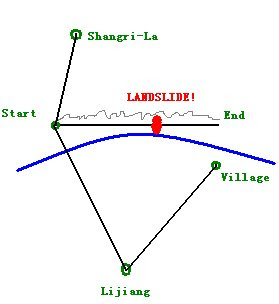
Until the avalanche came, scattering my belongings all around Yunnan to save weight seemed brilliant. But the landslide blocked the only road between the end of the hike and the start of the hike. Note the map below: The trail is in gray, the only road in black, the river through the gorge is in blue, and the landslide is in red. I am at the end of the hike. My stuff is at the start of the hike. I need to go to Lijiang.
It quickly dawned on me that I was in the middle of nowhere in Yunnan China, knew nobody, had a cell phone that didn't work, did not speak Chinese, was soaking wet, and all I had with me was about $50, a pair of dirty socks and underwear, and 1 last clifbar.
I hiked as fast as my tired legs would go uphill to a little cafe at the end of the hike. I got there around 12:30. There were 7 other travelers there including my new friend from Guangdong Province, another guy who turned out to be from Beijing, and 5 Israelis. I immediately attached myself to the hip of the two Chinese speakers.
After about 30 minutes of discussing the situation, we decided to hire a car for Y5 each to take us to the landslide. We would see if we could walk through it. If we could, we would hire a car on the other side to take us to the start of the hike. This seemed like a reasonable enough plan, so I hopped in a minivan (sidenote: the chinese word for minivan is loaf-of-bread-car) with the two chinese guys. The Israelis argued for about 20 minutes and finally 3 of them decided to come with us, leaving the other 2 temporarily at the cafe.
We headed off on the crazy, windy road with no guardrails and 2,000 foot sheer drops towards the landslide. Along the way, we passed about 3 small landslide areas any one of which undoubtedly would have closed any road in the US. We barely slowed down to avoid the boulders and waterfalls. Then, we saw it: the entire road was covered for about 30 yards with huge boulders. Definitely no cars getting through.
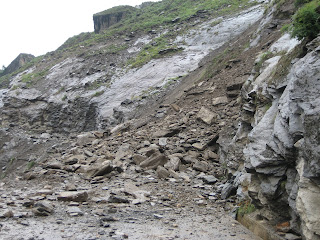
We got out to inspect the situation. It might have been possible to scamper through the landslide to the other side. The big problem was that there was still rocks that kept falling. Little rocks and dirt were falling continuously and would have made the ground very slick. Rocks about the size of a person's head fell every few seconds. They could probably be avoided, but if they hit you, they would definitely knock you off the cliff. And every few minutes, person-sized boulders would tumble down.
After discussing the situation for a few minutes, we decided to turn back. To punctuate the decision, a huge rock fell about 10 feet from where we were standing on the road. We quickly got back in the minivan and returned to the cafe. A mid-sized rock bounced off the side of the van as we drove off.

Along the way back to the cafe, I was discussing the situation with my new best friend from Guangdong. I told him that I needed to get back to the start of the hike to get my pack, so maybe I would just hike back. While walking 8 hours back to the start of the trail seemed far less than ideal, I couldn't come up with any better options. He suggested that I call the cafe at the start of the trail and have them send my bag to Lijiang. I was amazed at this idea. He explained the idea to the woman at the end of the trail cafe. She called the woman at the cafe at the start of the trail. After about 10 minutes of discussion, they said that I could pick up my bag that night at "Mama's" Guesthouse in Lijiang. It would cost me 15 Yuan (US$1.95) for the delivery. I quickly accepted the offer. Now all I had to do was get to Lijiang (and hope my bag did too).
Back at the cafe, I stayed as close to the lone minivan as possible. A few more travelers arrived and were also trying to sort out the situation. There were rumors that we could take a car to a ferry, take the ferry across the river, then try to find a car on the other side to take us to Lijiang. The two Chinese guys arranged for the minivan to drive us to this ferry crossing, so I hop in again. The Israeli's again tried to figure out how to split up. In the meantime, I met a white American guy! This was the first American I had met in 5 days in Yunnan. We got to talking and it turned out he is a CS Masters student at Stanford (Sergey) who was traveling with 2 Chinese-American Stanford girls (Carri and Diane)! I told them to quickly get in the van, we ditched the still arguing Israelis, and took off.

We drove along about 30 minutes mostly on these dirt farm roads through some corn fields vaguely towards the river. Eventually, the path ended, and the driver said we should get out. We paid him Y10 each, he pointed off in the distance, and said it is 500 meters to the water. We set off.
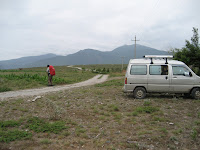
After nearly an hour of uncertain hiking (definitely more than 500 meters), we reached the cliffs and followed a winding path down to the river. Across the river, we could see a boat and a few caves where it looked like somebody could live. After a few minutes of yelling, a ferryman woke up, came down to the river, and brought his boat across the river to get us.
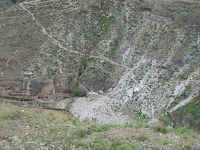

We took the ferry across the river for Y15.

On the other side, we climbed up a trail from the water to a dirt road. We followed this dirt road for about 30 minutes towards a cluster of buildings that was supposedly a village. Finally, we got to the first building which was a guesthouse. By now it was about 4:30. The two Chinese guys decided to spend the night at the guesthouse and take a bus the next morning to Shangri-La. The Stanford kids and I both wanted to get to Lijiang. There were no more buses. But the owner of the guesthouse eventually said that the village's one car could be hired to drive us to Lijiang for Y300 at 7pm. We accepted.
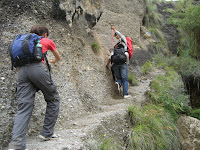
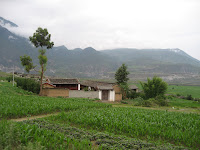
Still though, we had almost 3 hours to kill, so we wandered into "town". This was as stereotypical a Chinese village as you can imagine. One dirt road through town with a few shacks surrounding it. Chickens wandering in the street, a few donkeys, etc. The little kids all ran into the street and wave and yell at me and Sergey (I imagine not many white travelers make it in these parts). We did not see any cars for about 30 minutes.

Suddenly, a mini-bus rumbled down the street towards us. We flagged it down. After about 2 minutes of amazing negotiation by Diane, the mini-bus driver agreed to take us right then to Lijiang for Y300. We immediately jumped in and we took off, ecstatic that success was finally in sight.

A few small adventures later (we switched cars once and drivers twice for no apparent reason), we finally arrived after about 3 hours on bumpy dirt roads at Lijiang around 8pm. I found my way to "Mama's" within about 20 minutes, and sure enough my backpack was there, contents entirely intact! I have no idea how it got there.

Total cost of the trip: Y5 (car 1) + Y10 (car 2) + Y15 (ferry) + Y75 (bus) + Y15 (bag) = Y120 or about $15.

We decided to celebrate that night at a local bar which was of course named "The Sexy Tractor". And obviously, the bartender was a Chilean guy who used to live in Brazil. I told him I lived in Sao Paulo for a while, and we talked in Portunol for a bit. He pulled out some Cachaca from underneath the counter and made me an awesome caiprinha. Amazing end to a crazy day.

Shangri-La to Tiger Leaping Gorge

[Note: I am on the slowest internet connection in the world. More photos to follow soon]

I think I did not emphasize enough in my previous post how cool of a little town Shangri-La was. It's really small Tibetan village, with stone streets, little shops and restaurants and the occasional hostel, and two very cool monastaries - one on a little hill in town and one that we cycled to. There is also a big square where there is some sort of Tibetan dance party nightly. A little touristy, but still pretty cool. Some photos:

Monday morning I woke up in Shangri-La with no real plans, looked outside, saw that it was overcast but not raining, and decided to go do the Tiger Leaping Gorge hike. This is one of the most famous hikes in Yunnan Province, and runs through a gorge that is over a mile deep.

I left Shangri-La on the 10am bus for the little town of Qiaotou ("Chow-toe") where the hike starts. The bus was fairly nice - better than Ecuador, worse than Peru. I dozed off for a bit and woke up when the bus made a stop and then started again. Confused, I asked the guy next to me "Qiaotou?". He said something. Iasked again. He said something that seemed like yes. I yelled to the driver "Qiaotou?" He stopped. I hopped off, got my bag, and trudged back up the hill to Quiatou.

The Gorge hike is around 20 miles long. It starts around 1000 feet above the river at the west end of the Gorge. It then climbs up 3000 feet in the first 5 miles, then goes up and down and eventually descends back down to 1000 feet above the river over the last 15 miles. Top altitude is around 8500 feet. At the end of the hike, there is an optional 3 hour excursion down to the river.

Since the rainy season makes hiking tricky, my plan was to hike for as long as possible when it wasn't rainy too hard. I started around 1:00. As the weather rotated from light drizzle to steady rain but was never a downpour, I hiked until it started to get dark - about 6 hours. It was tough going, and quite slippery and wet, but a really cool hike. The mountains that surround the area are even higher than the gorge - their peaks are over 16,000 feet - and their tops poked through the clouds every so often like I was in the Lord of the Rings.

The weather scared away many travelers so I did not see very many people. But I also had a goofy wide-brimmed hat which I could tell made everyone I passed super jealous. I totally sunburned my newly exposed forehead, neck, and scalp while cycling outside Shangri-La. High-altitude sun and newly short hair do not go well together.

Most people I passed on the trail though had hired a guide with a horse. I hate horses even more than bikes so I did not. Still almost everyone I passed were also saoking wet and had mud-covered spots on their butts (like I did) from falling on one of the slick rocks. But I managed to find my way even though at times the trail was

not well marked:


crowded:

unclear:

probably not that safe:

and definitely wet:

But in the end, it was definitely worth it. The hike got progressively better, and it was awe-inspiring by the time I arrived Monday night at a little guest house that offered dinner and a place to crash for less than $4.

I woke up early and hiked the rest of the trail Tuesday morning, then trekked down to the bottom of the Gorge and climbed out on Tiger Leaping Stone in the middle of the river.

At the bottom of the river, I met a nice Chinese traveler from Guangdong province. As he was the only other person I saw on the 3 hour trip down to the river and back up, we chatted a bit and took a photo together. He took off first, I stayed a bit on the rock, then went up a few minutes later. As I was sweating and out of breath about half way back up, I ran into two guys who were headed down to the water. They mentioned that there had been a landslide in the road and that travel out of the gorge would be "challenging". That was an understatement - I will elaborate on the adventures that followed in the next post.

But the hike was exhausting, I was soaking wet for two days, but it was very cool, had great views, and was a great way to re-connect with nature after spending a month in the very urban lifestyle of Shanghai.