Today, two fortune tellers came to the office.
Softbank India is located in a pretty typical office building near Bangalore's main commercial district. Our building is 5 stories tall, and we are on the second floor. The office itself is fairly small - maybe 1,500 square ft - but big enough to comfortably fit the six people that work here.
It is not entirely unusual for people to come into our office selling strange goods and services. The other day, a man came in the front door of the office, and asked if I wanted a shave. Though I was curious to see how this would work at my desk, I declined.
Today's visitors came in, and both looked a little strange. One appeared to be a Sikh with a large red turban. He stood a step behind another gentlemen with bloodshot eyes and western clothes highlighted with a huge Levi's brass belt buckle.
These two men came in the front door, each holding a notebook. They quickly started chanting (in Hindi? Kannada?) and walking around the office. Then, they started staring intensely in people's faces and chanting to them.
Apparently, both men were face readers who, naturally, used people's faces to tell their fortune. The women who sits next to me was told that a bald man would soon be coming to assist her with a financial problem.
The face readers walked around for about five minutes (unfortunately skipping me, the openly staring Westerner) and told some more fortunes. Then, they invited us to their temple down the road for some sort of a ceremony this evening. Then, they turned and left.
Just another day at the office.
Thursday, August 16, 2007


Tuesday, August 14, 2007
Snake boat races
I spent Saturday at the immensely cool annual Nehru Trophy Snake Boat Races in Alappuzha, Kerala.
A little bit like a once-a-year NASCAR race, the Snake Boat race is a big annual party. Keralites from all over the state come to watch the race. And it's quite a spectacle.
Snake boats are really long, really skinny boats that people paddle like canoes. The biggest snake boats carry up to 135 people at a time (about 125 paddlers and 10 people clapping and banging drums to set the pace). Participants spend 4 to 5 months training for the race. Races are about 2 km long, with 4 boats racing at a time in each heat with the winners advancing.
I spent the weekend with my friend Dave from Sloan Business School, his roommate, and my new friend Madhu. Madhu arranged a boat for us to watch the race which was definitely the way to go. Since we were running late we had a bit of adventure and had to take a canoe to get out to our big boat just in time for the race. But we ended up making it without a problem.
People lined all along one side of the lake watching along the shore or in places in basic grandstands. Along the other side of the course, everyone who could get on a boat lined up and watched the races from the water, and generally sang and swam and had a festive time.
Here are a number of photos.
Rowing out to our main boat just in time for the start of the races

Snake boats in action The official umpires did nothing but occasionally wave a white flag
 The crowd was extremely festive. Actually, the boat next to us tried to start a fight with the next boat and a few people started throwing 2x4s. Nearly a disaster
 Sometimes coordinating 135 people doesn't work well. If people get off rhythm, the boat starts to fill with water and ends up sinking. This boat was stuck half under-water for about 15 minutes

The final race was the closest
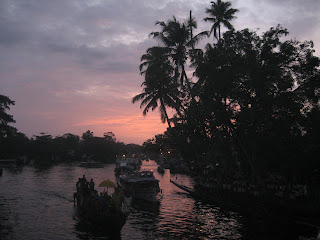
 Finally, the sun went down on a long, tough day of snake boat spectating

Monday, August 13, 2007
Women's role in Indian society
There is probably nobody less qualified to write about women than me. But Indian culture has some interesting and unusual aspects which I will try to briefly describe here.
India in some ways is a quite advanced in terms of women's rights. There is currently a woman president, there was a woman prime minister in the early 1980s, and there have been women in high government jobs throughout the 60 years of Indian independence.
Yet at the same time, everyday interactions between men and women are far different than they are in the West. They are also changing incredibly rapidly and a subject of much tension and debate in India.
I will ignore here the complicated issue of fundamental Islamic women who wear burkhas and do not speak to men, though this group makes up a meaningful portion of society here.
Employment
One of the things that I noticed upon arriving here was that men often work in jobs that would typically be filled by women in many other countries. For example, men typically clean rooms at hotels, do laundry, and perform housekeeping tasks. This was strikingly apparent at my hotel in Jaipur. Everyone who worked at any job inside the hotel was a man. Yet outside, there was some construction being done. This was being done by female workers, who carried bricks on their heads from one area of the hotel to the other.
I have talked with a few people about this issue. They attribute this to a few factors. First, female literacy significant trails male literacy here. This makes it hard for women to do jobs like wait tables. Second, even in most lower-middle class families, most women do not work but instead manage the household and raise the children. Finally, social norms often do not allow women and men to interact entirely freely, as noted above.
Conversation
In my experience, men rarely will address women who are accompanied by other men directly in conversation. At meals with women, the waiter typically addresses them men to see what the women would like. Buses have Ladies Compartments, and there are male and female lines at most ticket booths, security lines, and entrance gates. When Brittany and I went to a travel agent to book our trip in Leh, I needed to walk down the street to get a copy of my passport made. The male travel agent was not comfortable being alone in his store with a female, so he stood outside while I was gone.
Family Life
India has always struggled with run-away population growth. I have written about China's approach to the problem. Being a democracy, it is impossible for India to enforce something like a one-child, one-family policy. But the government has recently announced a new plan to curb population growth. The state has committed to pay R5,000 (US$250) for a "second honeymoon" to any couple who does not have a child in their first two years of marriage. They will pay R7,500 for any couple who does not have a child in their first three years of marriage. Over 85% of married couples have a child in their first two years of marriage, so the government hopes it can reduce the birth rate by encouraging people to wait longer to have children.
There are also massive problems with parents aborting female children (especially in rural areas). While this is somewhat similar to the problem in rural China, the dowry factor here makes the problem even worse.
Customarily in India, single men and women live with their parents until they get married. After marrying, the woman moves in with the man in his parents' house. At marriage, the bride's family pays a large dowry to the family of the groom.
This dowry can be a huge financial commitment for the bride's family, one that takes years of savings. As such, having female children in India is thought of by some as a financial burden. And tragically, as a result the ratio of males/females in rural India is now around 57/43.
The Karantaka government has recently announced a new plan to combat this. They are literally paying families to have female children. Girl children will receive free health insurance until they are 18 and a scholarship to pay for elementary schooling. They also become the beneficiaries of a life insurance policy that the state takes out on their parents. Finally, the parents will receive a lump sum payment of R30,000 when their daughter turns 18.
Finally, I learned a lot from my new friend Madhu this weekend about his family, including how he met his wife. They had a marriage arranged by their parents, as is common in traditional Indian culture. But this process is more complicated than I realized. When Madhu decided that he was ready to get married, his parents sent the details of his life (name, exact date and time of birth, etc) to an astrologer. She then compared those details with those of the women she had in her database, then recommended some matches to Madhu's parents. Madhu's parents then interviewed the parents of the potential matches, and chose one. Madhu met her once and they talked for a few hours. They then got engaged, and were married a few months later. They have been happily married for the past 15 years. And, only 1% of Indian marriages ends in divorce, so maybe there is something to be said for the zodiac!
Friday, August 10, 2007
Weekend plans
Bangalore is not the most happening town. There are some good shops and restaurants. Lots of movie theaters. A few bars that stay open until 11:30. But that's about it.
Last weekend, I had a nice, relaxing weekend. I went out to a couple great restaurants with some MIT business-school guys I have become friends with. We played golf at the "#1 golf course in India". I made a clutch birdie to win two Kingfisher beers (don't worry though, I still had 4 or 5 three-putts). I walked around town some, saw a movie, and did some shopping. But I think I have seen what there is to see in Bangalore.
I decided yesterday that I am going to Kerala for the weekend. This region in the southwest corner of India is known for its "backwaters". This weekend they are having the annual Snake Boat Race and Festival on one of the lakes. My first question, of course, was, "Does a snake boat race involve actual snakes?" Luckily, the answer is no, much like Chinese Dragon Boats do not involve actual dragons. So I decided to go check it out.
I do not know much about the backwaters, Kerala, or snake boats, but I am sure by the end of the weekend I will.
Thursday, August 9, 2007
Bollywood
Bollywood is a big deal.
And going to the movies here is quite an event.
In Jaipur, I went to one of the biggest and best theaters in the country. The lobby was amazingly decorated and an attraction in itself. Seats were purchased and assigned ahead of time. There were three tiers - much like going to a theater on Broadway. I bought box seats for R91 (~$2.25), and had a luxury box avoiding some of the chaos. Even though this theater only had one screen, it probably held 2,500 people. Here is a photo of the lobby.

The movie we saw was called Partner. Not uncommon for Bollywood films, it was based on an American film - in this cash Hitch. Same plot, similar jokes, even down to the fact that the main characters worked for a newspaper.
What was different though was the song and dance routines. Every 20 minutes or so, there was a huge song and dance routine, with elaborate costumes and choreography. These routines are quite common, and most movies feature around 8 major song-dance routines. Popular songs often show up on MTV India as videos, taken largely directly from the movies.
And the crowd gets into it. Whenever a star appears on screen, everyone yells. People sing and clap along with the songs. They scream and laugh and talk throughout and are as much of the entertainment as the movie itself.
This NYT article discusses Hollywood's latest efforts to capture some of the Indian cinema pie.
I also saw the Simpsons movie in Bangalore. Another very nice theater, though this was a 10 screen multiplex that could just as easily have been in suburban America (except for the assigned seats and talkative crowd). This theater was much smaller than Jaipur though, maybe since the movie was in english (ticket prices are also higher for english movies).
Finally, the story of Sanjay Dutt, arguably India's biggest movie star is quite amazing and quite current.
India just went through its equivalent of the OJ trial. Sanjay is one of Bollywood's biggest stars. He was arrested after the 1993 Mumbai bombings and charged (along with a few hundred others) with arms trafficking. He spent a year and a half in prison from 1994-95 but was then released on bond while awaiting trial.
His trial just concluded, 14 years later (Indian courts don't move fast). He was found guilty and (quite surprisingly to the public and the Bollywood community) sentenced to six years in prison. The three movies that he is in the middle of filming right now have all been shelved. The "Bollywood fraternity is mourning" (though public reaction seems mixed). But the Sanjay story is definitely all over the news. We know everything from Sanjay's prison sleeping schedule to what type food he is served to the cleanliness of the toilets in his cell block.
Nobody though seems to discuss whether he actually committed a crime. Maybe this was settled long ago, I am not sure. I have asked a few people about it but nobody seemed comfortable talking about it - I think (understandably) the bombings are still a sensitive topic. He is currently appealing to the Supreme Court but will remain in prison at least until it decides whether they will consider his case and allow him out on bail again. I will post further updates as new developments unfold.
Wednesday, August 8, 2007
Photo Hunt
I have finally gotten around to uploading a bunch of photos from my travels between Shanghai and Bangalore. Here are some highlights in random order.


Me, sad Tibetan woman, Yak

 Ferryman's house, somewhere near Tiger Leaping Gorge
 Yak tea with Tibetan monk, Shangri-La
 Mountains near Shangri-La
 Main Square, Shangri-La
 New friends, Shangri-La
 Random temple on bike trip, somewhere near Shangri-La
 Field of flowers (poppies?), near Shangri-La
 Much needed rest, near Shangri-La
 Monastary view, near Shangri-La
 Tiger Leaping Gorge
 Tiger Leaping Gorge
 Tiger Leaping Gorge
 Tiger Leaping Gorge
 Tiger Leaping Gorge
 Tso Moriri, Ladakh
 View from teahouse, Lijiang
 Riverfront cafe, Lijiang
 Main square, Macau
 Winding mountain roads, Ladakh
 Well-decorated truck ("Fruit King"), Ladakh
 View from airplane, Leh
 Tso Kar, Ladakh
 Runaway camel, Rajasthan
 Finding some shade, Taj Mahal
 Ruins, Jaipur
 Fort, overlooking Jaipur
 Sunset with Tibetan prayer flags, Ladakh

Karoake in Shanghai

A taste of America in Hong Kong
Sign in Yunnan
Sign in Macau Lotus temple, Delhi

Sign in Yunnan

Sign in Macau
 Lotus temple, Delhi

Me, sad Tibetan woman, Yak

Monastary, near Shangri-La
 Ferryman's house, somewhere near Tiger Leaping Gorge
 Yak tea with Tibetan monk, Shangri-La
 Mountains near Shangri-La
 Main Square, Shangri-La
 New friends, Shangri-La
 Random temple on bike trip, somewhere near Shangri-La
 Field of flowers (poppies?), near Shangri-La
 Much needed rest, near Shangri-La
 Monastary view, near Shangri-La
 Tiger Leaping Gorge
 Tiger Leaping Gorge
 Tiger Leaping Gorge
 Tiger Leaping Gorge
 Tiger Leaping Gorge
 Tso Moriri, Ladakh
 View from teahouse, Lijiang
 Riverfront cafe, Lijiang
 Main square, Macau
 Winding mountain roads, Ladakh
 Well-decorated truck ("Fruit King"), Ladakh
 View from airplane, Leh
 Tso Kar, Ladakh
 Runaway camel, Rajasthan
 Finding some shade, Taj Mahal
 Ruins, Jaipur
 Fort, overlooking Jaipur
 Sunset with Tibetan prayer flags, Ladakh

Tuesday, August 7, 2007
Indian airport security
India is often thought of in the US as a great place to outsource business processes. Some of the processes here though are absolutely ridiculous. I will describe the process for boarding a plane, which I have now been through 4 times and am just starting to understand.
First, to enter the airport you have to show your ticket to a military policeman at the airport door. If you only have an e-ticket, you have to go to a little stand that is setup for this purpose outside the airport and print a copy of your itinerary from the internet. Then you can show the guy at the airport door a ticket and enter the airport.
Upon passing the guard at the door, men have to go through a metal detector (#1). Women do not. To go through this metal detector, you do not need to take your bags off, you just walk through it, set off the alarm (luggage almost always has metal), get patted down and move on.
After entering the airport, you walk through the lobby towards the check-in counters. But to get to the check-in counters, you must have all your checked baggage x-rayed. To get your bags x-rayed, you need to put a bag-tag on them. Then you walk through the metal detectors again (#2) - both men and women this time, though there is a separate Ladies Line - get patted down and go to pick up check-in baggage. Check-in bags need to get stamped on the bag-tag by security or they won't be accepted for check-in.
Then you check-in. This process is not particularly unusual, except you need to get bag-tags for carry-on bags.
After checking-in, you need to go through security to get to the gates. To do this, you need
to go through a metal detector (#3), get patted down, and get the bag-tags on the carry-on bags stamped.
Once you find your gates, then you have the check-in baggage identification. All bags that are going to be checked for the flight get piled up by the gate for that flight. Before boarding, you need to go to the pile of bags and point to your bags. Then your boarding pass gets a mark written on it and your bag gets marked.
Here is my backpack with destination Jaipur (JAI) marked in chalk.
Finally, to board the plane, there is a final wanding with a metal detector (#4), a final x-ray of the carry-on bags, and an inspection of the boarding pass markings and the bag-tag stamps on the carry-on bags. If all is successful, you are allowed onto the bus that takes you to the plane.
Why 4 (or 3 for women) metal detector screenings and numerous stamps are needed to board a plane is not clear. I guess labor is cheap and plentiful but not especially trustworthy. Still, most foreign travelers find this process more than a bit confusing.
Some travelers, however, get special exemptions from the security process. Note numbers 17 and 19 below.
First, to enter the airport you have to show your ticket to a military policeman at the airport door. If you only have an e-ticket, you have to go to a little stand that is setup for this purpose outside the airport and print a copy of your itinerary from the internet. Then you can show the guy at the airport door a ticket and enter the airport.
Upon passing the guard at the door, men have to go through a metal detector (#1). Women do not. To go through this metal detector, you do not need to take your bags off, you just walk through it, set off the alarm (luggage almost always has metal), get patted down and move on.
After entering the airport, you walk through the lobby towards the check-in counters. But to get to the check-in counters, you must have all your checked baggage x-rayed. To get your bags x-rayed, you need to put a bag-tag on them. Then you walk through the metal detectors again (#2) - both men and women this time, though there is a separate Ladies Line - get patted down and go to pick up check-in baggage. Check-in bags need to get stamped on the bag-tag by security or they won't be accepted for check-in.
Then you check-in. This process is not particularly unusual, except you need to get bag-tags for carry-on bags.
After checking-in, you need to go through security to get to the gates. To do this, you need
to go through a metal detector (#3), get patted down, and get the bag-tags on the carry-on bags stamped.
Once you find your gates, then you have the check-in baggage identification. All bags that are going to be checked for the flight get piled up by the gate for that flight. Before boarding, you need to go to the pile of bags and point to your bags. Then your boarding pass gets a mark written on it and your bag gets marked.
Here is my backpack with destination Jaipur (JAI) marked in chalk.

Finally, to board the plane, there is a final wanding with a metal detector (#4), a final x-ray of the carry-on bags, and an inspection of the boarding pass markings and the bag-tag stamps on the carry-on bags. If all is successful, you are allowed onto the bus that takes you to the plane.
Why 4 (or 3 for women) metal detector screenings and numerous stamps are needed to board a plane is not clear. I guess labor is cheap and plentiful but not especially trustworthy. Still, most foreign travelers find this process more than a bit confusing.
Some travelers, however, get special exemptions from the security process. Note numbers 17 and 19 below.

Subscribe to:
Posts (Atom)